
Matei Alexianu is a law clerk on the U.S. Court of Appeals, JD graduate from Yale Law School and former Editor in Chief of the Yale Journal of International Law
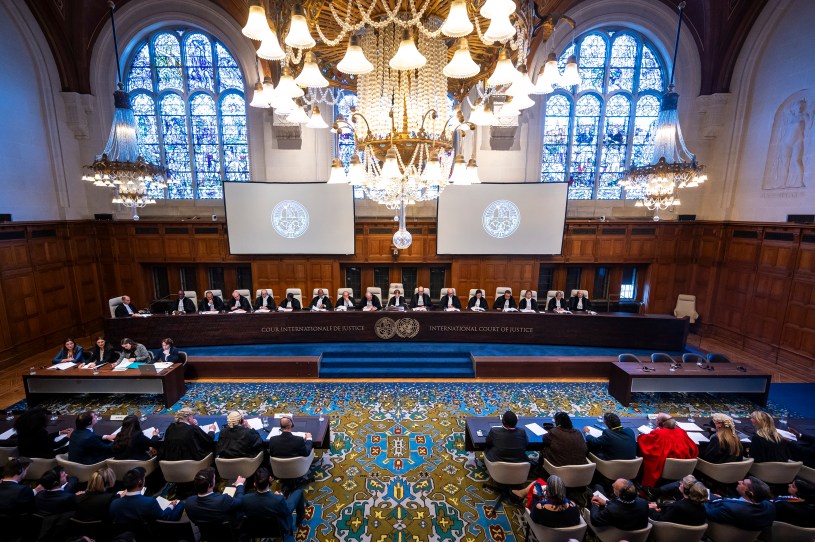
On January 26, the International Court of Justice issued its much-anticipated provisional measures order in South Africa’s case against Israel alleging genocide in Gaza. In it, the Court ordered Israel to “take all measures within its power” to prevent and punish genocide in Gaza, including public incitement, to allow basic services and humanitarian assistance to enter Gaza, and to preserve any relevant evidence. The measures were nearly unanimous: of seventeen judges, only two (and for some measures, just one) voted against.
Most of the world’s attention will understandably now turn to whether Israel complies. Statements by its government officials, including from Israeli Prime Minister Netanyahu himself, cast serious doubt on that possibility. The Court cannot enforce its decisions, and recent history suggests that the U.S. would block any enforcement attempts in the U.N. Security Council. Anything less than full compliance by Israel will lead to a new round of pronouncements about the ineffectiveness of the Court—and perhaps international law itself. But that would be short-sighted. The critique misses three other functions of the order besides an immediate change in Israel’s behavior: it mobilizes international efforts to curb the conflict, shapes the parties’ expectations and strategies in the case, and—most broadly—reaffirms important values of the international community.
At the outset, it’s worth mentioning that the case has already had some impact on Israeli policy. On the eve of the provisional measures hearings, Israel’s Attorney General issued a statement warning that calls for intentional harms to civilians “may constitute criminal offenses.” And a few days before the order, Israel declassified documents purporting to show that its leadership has sought to protect civilian lives during its Gaza campaign. It is clear that the Israeli government is taking this case, and its reputational consequences, seriously.
At the risk of being repetitive, it is important to keep in mind the provisional nature of the decision. As Judge Bhandari pointed out in his declaration, the order does not declare that Israel has committed genocide—or even violated international law at all. Here, the Court has decided three things: (1) that it has prima facie jurisdiction, (2) that Palestinians have a “plausible” right to be protected from genocide (and South Africa has a right to ensure this), and (3) that measures are urgently needed to prevent irreparable harm to those rights. The most important implication is that South Africa’s claim that Israel has committed, or failed to prevent, genocide is plausible. That, in and of itself, is significant (as one scholar has noted). But plausible is not the same as probable. Granting provisional measures does not prevent the Court from later dismissing the case for lack of jurisdiction (as it did in Qatar v. United Arab Emirates) or ruling for the other side on the merits (as it did in Equatorial Guinea v. France). And it will be very difficult for South Africa to prevail on the merits, given what Judge Nolte highlighted in his declaration as the “high threshold” definition of genocide.
Enforcement through international pressure
Even so, the order is significant. Start with international pressure. As Cameron Miles has written, the ICJ operates as part of a wider network of international and domestic institutions that can apply pressure on parties to settle their disputes—an integrated dispute settlement system. This concept typically refers to a set of national and international courts that may issue binding orders on the parties. But political organs play a role, too. A recent paper highlighted the “dialogic function” of ICJ provisional measures in promoting action by the U.N. Security Council and General Assembly.
Here, the order will likely strengthen the growing chorus of voices, including among Israel’s allies, calling for the country to change course in Gaza. Critics will point to the order—and any sign of Israel’s defiance—as evidence that Israel is acting illegally. At the U.N., there will probably be more votes calling for a ceasefire, but this time with the added weight of the Court’s order. That weight will be particularly heavy if accompanied by concrete evidence that Israel is breaching any of the orders (with the humanitarian aid measure likely being the easiest to monitor). In the Security Council, pressure will mount on the United States, which has previously lambasted Russia for blocking Security Council measures despite Court orders against it.
Even if the international arena remains blocked, the order is likely to have some practical bite domestically. In the Netherlands, for example, human rights groups have sued to block the government from providing airplane parts to Israel because they may be enabling violations of the laws of war. In their case, one scholar has pointed out that the plaintiffs could use the provisional measures order in their pending appeal as evidence that the Dutch government is now on notice of possible crimes.
In the United States, there are several ways the order could make a difference to policy. The Biden administration’s Conventional Arms Transfer policy states that the U.S. will not transfer weapons when they will “aggravate risks that the recipient will commit” genocide, crimes against humanity, and certain violations of the laws of war. The State Department has also developed guidance for monitoring the civilian harm inflicted by U.S. weapons abroad. Calls will inevitably grow for more executive oversight of weapons use in Israel, especially given the mounting internal opposition to the administration’s policies. In the Senate, lawmakers might use the order to revive calls for a resolution tying military aid to Israel’s respect of international law.
There is ample precedent for this kind of pressure. After the Court ordered Russia to stop its invasion of Ukraine in 2022, a wave of international and domestic measures to force Russia to comply followed. For instance, two U.N. General Assembly Resolutions referencing the Court’s order passed with large majorities. Of course, the pressure has failed to curb Russia’s aggression and the war continues. But, unlike Russia, which initially refused to even appear at the Hague, Israel is mindful of its international reputation. And it relies on its Western allies for support, which makes any pressure more likely to be effective.
Shaping the rest of the case
Second, the order has informational benefits for South Africa and Israel, along with any potential intervenors. In general, provisional measures orders provide a “data point” to states deciding how to act in a dispute. Through them, the Court sends a signal to the parties about their underlying legal relationship, including who is likely to prevail on the merits. Of course, that signal can vary in strength. In this case, where both the order itself and several of the separate opinions stressed the limited burden of showing plausibility, the signal is on the weaker side.
Nevertheless, the order and the appended opinions convey valuable information. The overwhelming majorities voting for the measures—including, for some of the measures, Israeli judge Barak—will encourage South Africa that it has a viable case, at least sufficient to survive preliminary objections. It will take note of Judge Xue’s remark that “this is the very type of case” where the Court should accept erga omnes partes standing. And, as to the merits of the dispute, it will also have learned that Judge Nolte, while generally skeptical of South Africa’s claims, is concerned about statements by Israeli officials that might plausibly constitute incitement to genocide. Israel, meanwhile, will take solace in the repeated clarifications that the Court is merely deciding that South Africa’s claims are plausible, and Judge Sebutinde’s dissent at this early stage.
Expressing international legal norms
Third, the decision has expressive value. The order highlights the disturbing realities of the conflict. It points out the “massive civilian casualties” and “catastrophic humanitarian situation” caused by Israel’s military response, citing U.N. officials’ statements that Gaza has become “uninhabitable” and a “place of death and despair.” And it speaks of Hamas’ “horrific attacks” on October 7 and expresses its “grave concern” about the fate of the Israeli hostages, calling for their “immediate and unconditional release.” Spoken by the nearly unanimous judges of the World Court, hailing from six continents, these acknowledgements have symbolic weight.
Moreover, the order reaffirms two bedrock principles of international law: the obligation to prevent and punish genocide, and the responsibility to abide by international humanitarian law during conflict. Significantly, the order explicitly reaffirms the standing of all states that have signed the Genocide Convention to bring cases in the Court based on their “common interest” in preventing genocide. This doctrine, which could revolutionize human rights enforcement, has solidified so quickly in the last few years that Israel did not challenge it at this stage.
The order also demonstrates the power of the common language of law. Regardless of the ultimate outcome, in a few short weeks the South Africa v. Israel case has already compelled Israel to justify its conduct in universally recognizable terms and sparked a global conversation about human rights during conflict. Far from demonstrating impotence, the order confirms the ongoing (and perhaps even growing) role of the Court and international law in addressing conflict.
 International Law Blog