
By Laurence Teillet, Nottingham Trent University*
As conversations emerge regarding the reform of the international crime of piracy (as analysed in a previous blog post), it is worth considering whether its conservation as an international crime remains relevant. Undoubtedly, maritime security threats persist and demand serious attention. However, we ought to question whether the traditional notion of piracy, deeply rooted in colonial history, is best equipped to address contemporary security challenges without perpetuating historical and political power dynamics.
This blog post aims to highlight the colonial origins of the concept of piracy, discussing its historical use and examining its contemporary manifestations. While it does not directly answer the question of whether piracy should be conserved or abandoned, it seeks to enrich the debate by providing pertinent context and advocating for a less Western-centric approach to the Law of the Sea.
It does not, under any circumstances, justify violence at sea. Rather, it aims to explore a specific historical and political context surrounding the definition and use of piracy as a criminal incrimination.
Western-Centred Law of the Sea
Piracy is commonly perceived as the ultimate violation of the principle of freedom of the seas – often described as the cornerstone of the Law of the Sea. However, a shift away from Eurocentric interpretations of the Law of the Sea reveals two significant points. Firstly, the supposed consensus surrounding the foundation of the Law of the Sea reveals underlying power dynamics that reinforce colonial dominance and negate alternative traditional and indigenous approaches to the sea. Secondly, it suggests that the origins of piracy may be connected with the very structures designed to combat it.
In the late 16th century and early 17th century, Portugal and Spain declared their dominance over the seas, claiming exclusive rights to maritime trade and navigation. In response to these aggressive claims and to challenge their monopoly over commerce, the Dutch lawyer Hugo Grotius, representing the Dutch East India Company, developed the concept of freedom of the seas in his work Mare Liberum published in 1609. Motivated by patriotism, Grotius advocated for unrestricted access to the seas and the freedom to engage in trade.
According to the doctrine of freedom of the seas, as defended by Grotius, not only the Dutch but all nations possess the right to navigate to regions like the East Indies and engage in trade with their inhabitants. Grotius supported his argument by invoking the principles of natural law, arguing that these laws, inherent and universally recognised as originating from God, were applied to all.
Yet, while Grotius constructed his argument based on natural law, the doctrine of freedom of the seas principally emerged to safeguard the national interests of the Netherlands, as evidenced by the historical context surrounding the publication of Mare Liberum.
Western colonisers largely disregarded indigenous approaches to the Law of the Sea and granted European maritime powers unrestricted access to marine territories and the opportunity to exploit marine resources that were traditionally used by native inhabitants, disregarding the latter’s customary rights to the sea and its resources. Grotius’ belief in the inexhaustibility of marine resources further fuelled the overexploitation of these resources. This overexploitation, intensified by the direct impacts of colonialism in specific regions, served as a catalyst for the emergence of piratical activities.
A New Reading of Piracy
For instance, the rise in piracy near the Horn of Africa since the mid-1990s directly correlates with Somalia’s lack of effective governance, itself resulting from colonialism. Following Somalia’s partition by colonial powers and subsequent independence, political instability followed, culminating in a failed state with no central authority. Exploiting this chaos, European vessels dumped hazardous waste into Somali waters, causing health issues and devastating marine life. Simultaneously, foreign trawlers are illegally capturing over $300 million worth of marine resources annually, severely impacting coastal communities reliant on fishing. Piracy arose in response to these crises, offering both resistance to environmental degradation and a means of survival for affected communities. Empirical evidence, including qualitative studies, corroborates the link between piracy and issues like illegal fishing and state fragility, highlighting the complex socio-political context underlying piracy’s emergence.
The Western-centric Law of the Sea system not only set the stage for the rise of piratical activities but also imbued the label of pirate and the concept of piracy with strong colonial connotations. Firstly, any deviation from the established governance and perception of the Law of the Sea was branded as piracy, leading to severe consequences for those involved. Secondly, this notion of piracy was often manipulated opportunistically by powerful states to suit their interests and agendas.
Piracy is frequently presented as a universally condemned crime, and the efforts to combat piracy are often presented as one of the few challenges that states collectively agree upon. Some academic scholars have argued that “the consensual enemy must give rise to consensual opposition”. Yet, the notion of the “pirate enemy” was not as universally accepted as often portrayed. A linguistic analysis reinforces this argument. Asian languages include several expressions that modern scholarship has interpreted as piracy, although there is no equivalence in meaning and association. Similarly, prior to the influence of European states, terms such as ‘pirate’ and ‘piracy’ were absent in Islamic territories. The closest terminology found in the Quranic tradition refers to “highwaymen” and “highwaywomen”. The contemporary terms for “pirate” and “piracy” in Arabic, as used today, are derived from a corrupted version of Italian.
In addition, piracy frequently served as a means to challenge alternative governance structures that diverged from the narrative of powerful states. Müller’s recent research has demonstrated that what powerful states labelled as “piracy” in Southeast Asia was not merely an occasional occurrence or a byproduct of trade – it was, in fact, an integral component of the economic structure and political organisation in numerous coastal communities. Consequently, these so-called “pirates” were not societal outcasts but members of their communities and exercised significant political influence.
“This did not imply that these seas represented a lawless space; rather, (…) it made up an unruly oceanic space in which the state appears not as the sole purveyor of legitimacy but as one actor among many, in a multi-vocal and plural legal environment where a diversity of religious laws and legal cultures intersected, coexisted and competed”.
Nonetheless, it was the fight against so-called “piracy” that often served as a pretext for the colonisation of these territories – also marked by the use of exclusionary and demonising language, often infused with religious connotations, particularly Christian ones.
Even in instances where powerful states were not explicitly imposing their governance onto other legal traditions, they opportunistically manipulated the notion of piracy to further their agendas. The distinction between piracy and privateering exemplifies this opportunistic approach. Privateering, essentially state-sanctioned piracy, was deemed legal until the 1856 Treaty of Paris. However, when State A engaged in privateering, State B would label it as piracy, and vice versa, as a means to assert dominance over less powerful states.
The misuse of the labels “pirates” and “piracy” also extended to cases where piracy did not apply, purely driven by political motives. An illustrative example is the myth of “Arab pirates”. In the late 18th century, after securing cooperation from the Persians and Omanis, the British targeted their persistent rivals, the Qawāsim, who conducted profitable maritime trade unrelated to piracy. Every incident, even those where the Qawāsim could not have been involved, was attributed without a doubt to the aggression of the Qawāsim “pirates”. The British Empire crafted a narrative, spreading the belief in the existence of “Arab piracy”, despite historical evidence suggesting otherwise.
Similar developments can be observed today in a different context. In 1982, the first accusations of piracy were levelled against environmental activists engaging in direct action at sea. Subsequently, the first official judgment labelling environmental activists as pirates was issued in 1986, with further cases in 2013. By 2015, the same “piracy analogy” employed against Eichmann in Jerusalem was relied upon to stop Greenpeace’s environmental operations against Shell. A narrative is being constructed, and its consequences are evident: whereas labelling environmental activists as pirates was once regarded as an isolated and problematic precedent in the early 1990s, today any high-profile protest action at sea conducted by environmental activists prompts the general public to brand them as “pirates” – all within a context where approximately 200 environmental defenders are killed every year.
In a context where the label of “piracy” and “pirate” is laden with extremely dehumanising language – “rightless enemies”, “enemies of mankind”, “the worst of crimes and the worst of men” – it is essential to question its contemporary acceptability. Is it still fair to brand impoverished fishermen, driven to violence by the devastating consequences of colonisation, as “pirates”, carrying all the historical and political baggage associated with the term? Is it justifiable to call environmental activists “rightless enemies”, precisely when the European Court of Human Rights reaffirms the right to freedom of expression even through disruptive direct actions?
Concluding Notes
All this historical and contemporary background illustrates the colonial origins of the concept of piracy, raising the question of whether this problematic crime remains relevant today without exacerbating existing issues. As mentioned in the introduction, the author does not justify violence or downplay maritime security threats. However, it demands consideration of whether the label of piracy is still necessary. Many instances of piracy today could be prosecuted under alternative legal frameworks. Similarly, emerging security threats such as the Nordstream 2 sabotage, the Red Sea crisis, or historical hijacking incidents provide relevant examples where piracy has been useless in addressing security threats.
Perhaps the most effective reform of piracy lies in its complete abandonment and the establishment of a new regulatory framework under a neutral terminology – a topic deserving of further exploration in a subsequent blog post. This framework should incorporate appropriate safeguards and levels of severity, along with corresponding jurisdictional rights, to mitigate the potential misuse of the powers associated with the crime.
*I extend my sincere gratitude to Deladem Ohenewaa Mensah from Nottingham Trent University, Cosmos Nike Nwedu from Kampala International University and Ahmad Ali Shariati from the University of Sussex for their kind review and thoughtful comments.
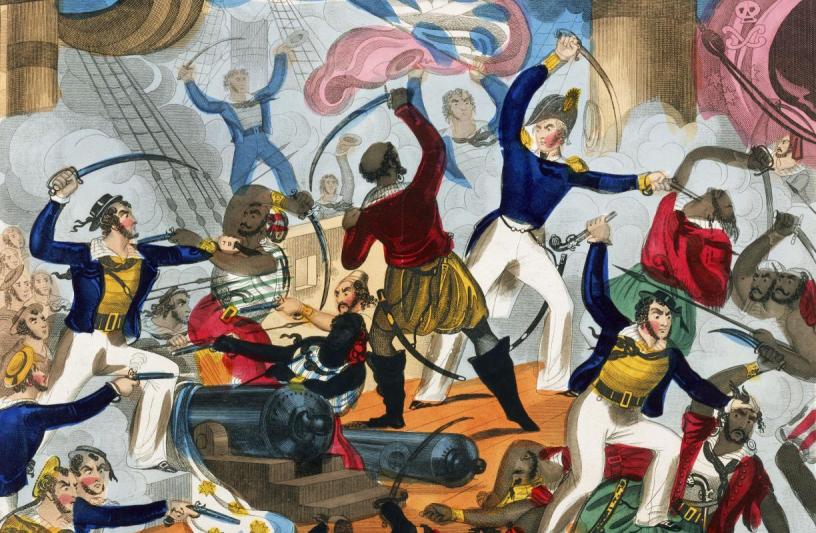
Painting: An Algerine pirate ship, John Fairburn (1793–1832) – National Maritime Museum, Greenwich, London.
 International Law Blog
The thought-provoking post by Dr. Laurence Teillet on the vexatious issue of piracy raises many an important question. Epistemology and ontology of piracy have a connection with Europe, colonialism and Christianity. With the passage of time as the world became politically decolonised, the outdated notions of piracy and the relevant international legal framework should have been reformed. It, however, is yet to happen because the intellectual hangover of colonialism is still there. There is no doubt that safety and security of vessels passing through international waters must be assured. Most of the international trade is conducted through sea routes. Illegal actions that hamper legitimate international maritime traffic ought to be controlled. Root causes of piracy should be tackled and willful defaulters deserved to be sternly dealt with. Peace, justice, security and freedom must be guaranteed by nipping the crime of piracy in bud.
LikeLike
I have suggested elsewhere that any development of the law relating to ‘piracy’ as defined in both the 1958 High Seas Convention and 1982 UNCLOS, would need to consider the application of the SUA Convention (which emerged as a consequence of the hi-jacking of the MS Achille Lauro in the Mediterranean in 1985). It is most unlikely that the conventional definition of piracy will be amended in any way. Rather, some measure of universal jurisdiction might be introduced within the SUA context…although this would be politically problematic. See S.Haines, ‘The MS Achille Lauro Hi-jacking’ in Letts and McLaughlin (Eds) Maritime Operations Law in Practice: Key Cases and Incidents, Routledge, 2023, pp.37-49
LikeLike
Thank you, Professor Haines, for your comment and the recommended reading! It was very interesting.
The relationship between the UNCLOS regime and the SUA Convention has always been a subject of headache for me! The emergence of the SUA Convention, in my view, is closely linked to the issues surrounding the interpretation of the “private ends” requirement within Article 101 of UNCLOS. This requirement has been particularly controversial, as it creates uncertainties about whether politically motivated acts of violence can – or should – be classified as piracy. The hijacking of the Achille Lauro is a perfect example, where the politically motivated nature of the act, coupled with the absence of the two-ships requirement associated with piracy, showed the limitations of the UNCLOS framework.
The SUA Convention was, therefore, a necessary evolution to address these limitations, particularly to ensure that politically motivated acts of violence at sea would not escape legal accountability. The sponsoring States – Austria, Egypt, and Italy – expressly pointed to the ambiguity surrounding UNCLOS’ “private ends” requirement as a justification for the Convention’s creation.
Regarding your point on universal jurisdiction, I believe the issues surrounding the “private ends” requirement also influence why the SUA Convention lacks universal jurisdiction. Dr. Mark Chadwick would make this argument better than me, but I believe that the historical/colonial context of piracy as a crime against “all civilised nations” contributed to the jurisdictional status of piracy under international law. In contrast, politically motivated offences potentially covered by the SUA Convention, particularly those involving rebel groups against specific states, lack this perceived universality of piracy’s indiscriminate animus – justifying jurisdiction mainly for the directly impacted states. These offences may be more context-specific.
That said, I acknowledge that the historical justification for universal jurisdiction in the context of piracy is theoretical and opportunistic, as I discussed in the blog post. The universality attributed to piracy was constructed and does not show well in history and do not always translate into consistent or equitable application in practice.
The SUA Convention might offer a way to move beyond the theoretical indiscriminate animus requirement, which, in my view, has never truly existed in practice for piracy but continues to serve as the implicit foundation of the legal regime? However, to achieve this, I believe we should abandon the terminology of piracy altogether.
I feel like my comment raises more questions than it answers… 😁
LikeLike