
By Konstantinos D. Magliveras, Professor of Public International Law, University of the Aegean, Greece.
I. Introduction
For those living in the so-called Western world, what constitutes a ‘democracy’, and which regimes are ‘democratic’ is pretty much a settled matter. Moreover, there exist certain IOs whose members are a priori considered to be democratic states, e.g. the EU (article 2 Treaty on European Union) and the Council of Europe (article 3 in conjunction with article 1 Statute). However, these Western countries do not necessarily have the monopoly to use the words ‘democracy/democratic’, not to mention all those countries that call themselves ‘democratic republics’. This article ponders on the uses of ‘democracy/democratic’ in the international community and possible pitfalls.
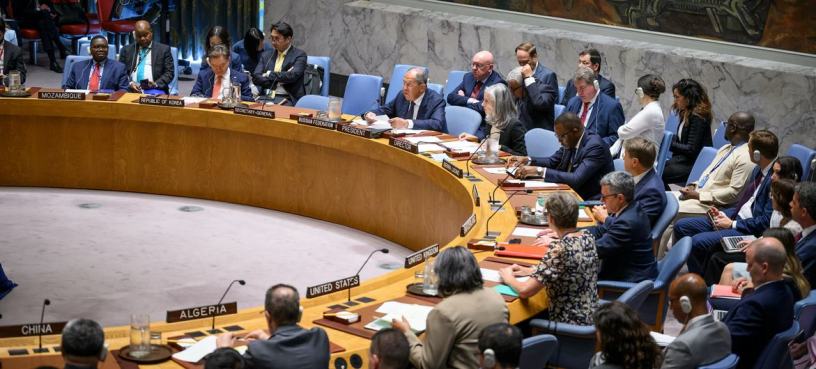
After recalling the Warsaw Declaration: Toward a Community of Democracies adopted on 27 June 2020, it discusses two multilateral events where ‘democracy/democratic’ was a central theme potentially showing that there can be more ‘democracies’. First, the Declaration of the Shanghai Cooperation Organisation Summit in Astana, Kazakhstan of 4 July 2024. Second, the UN Security Council open debate on ‘Multilateral cooperation in the interest of a more just, democratic and sustainable world order’, organized by the Russian presidency on 16 July 2024.
II. The Warsaw Declaration
Today, it rather sounds improbable that 106 countries, including Haiti, Russia, Venezuela, Yemen, Mali, Qatar, and Burkina Faso, would get together and adopt a Declaration creating a ‘Community of Democracies’ (CoD) and agreeing to 19 principles encompassing democracy, human rights, and the rule of law. But this was exactly what happened in Warsaw almost 25 years ago. CoD describes itself as having ‘gradually developed from a conference initiative into a global intergovernmental coalition of democratic states’. Since all CoD countries are regarded as ‘democratic’, arguably there are more than one ‘democracies’. Indeed, the Warsaw Declaration recognized that the signatories were ‘at different stages in democratic development’. However, a cursory look at their political and electoral systems reveals that they differ considerably. It follows that which countries are ‘democracies’ (or not) is a reflection of how this, that or the other group of states characterizes its members and not a determination based on objective criteria.
III. The Astana Declaration
The Shanghai Cooperation Organisation (SCO) is a regional politico-economic and collective security organisation. Together with the new tenth member (Belarus), their total population is around 3.4 billion people, while four members have (officially) nuclear weapons (Russia, China, India and Pakistan). To understand how the so-called ‘Shanghai Ten’ perceive democracy in the Astana Declaration, reference will be made to the following three points to be read together. First, the acknowledgment that ‘[t]ectonic shifts are underway in global politics, economy, and other spheres of international relations … broader use of force, regular violations of international law, growing geopolitical confrontation and conflicts …’. Second, the realization that ‘[a] fairer multipolar world order is being born, with broader opportunities for national development and mutually beneficial and equal international cooperation’.
The third point is that member states remembered that a SCO goal and task, under Article 1 Charter, concluded 22 years ago, is the ‘promotion of a new democratic, fair and rational political and economic international order’. According to the Declaration, ‘[r]elying on the similarity or unity of views on the current regional and international agendas, [member states] reaffirm their commitment to creating a more representative, democratic, fair and multipolar world based on the universal principles of international law, cultural and civilisational diversity …’ (emphasis added). In effect, regardless of whether SCO members are democracies, they want to create a ‘democratic’ world.
To build this ‘new democratic and fair political and economic world order’, continues the Declaration, it is necessary to boost SCO’s role in creating a stronger universal peace, security and stability. This task will be channeled through the ‘Initiative, on World Unity for a Just Peace, Harmony and Development’, which was endorsed at the Astana Summit, forming the basis of ‘sustainable development of international relations’. Member states will promote the latter by respecting, inter alia, the right of peoples to an independent and democratic choice of paths in achieving political and socio-economic development (emphasis added). The international community has been invited to join the Initiative. However, when during the Astana Summit the President of Kazakhstan proposed the Initiative’s implementation, there was no reference as to what a ‘democratic multipolar world’ and the ‘democratic choice of paths’ entail.
III. The open debate at the UN Security Council
Russia’s concept note on the debate was circulated on 9 July 2024 (S/2024/537). It bears considerable similarities with the Astana Declaration, as it talked about how ‘the emerging multipolar world opens a pathway to a genuine democracy in international relations’. It also mentioned the importance of offering UN members the opportunity to engage in detailed and ‘out of the box’ exchanges ‘on a possible new vision for a global architecture and principles of international relations in the twenty-first century … to avoid a global conflict and build a just, democratic and sustainable global system’. Finally, the concept note asked how the UN can ‘adapt to the emerging polycentric realities and contribute to the establishment of a just, democratic and sustainable international order’ (emphasis added).
If anyone expected that a thought-provoking exchange of opinions would take place, one was sadly disappointed. The deliberations and the statements made at the meeting (9686th Meeting) had nothing to do with the organizer’s aim for a ‘strategic discussion on the future security architecture beyond the horizon of the current crises’. They were dominated by whether Russia flagrantly violates the UN Charter (USA, UK), whether NATO is a ‘troublemaker’ (China), which members promote self-serving political agendas (Iran), etc. The word ‘democratic’ appears in only four members’ statements but no explication of its substance was given. In particular, Sierra Leone said that ‘we cannot champion a just, democratic and sustainable world when Africa … remains excluded in the permanent category and underrepresented in the non-permanent category of membership in the [UNSC]’. While it was not clarified what the UNSC enlargement has to do with a ‘democratic world’, presumably the reference was to equality of representation being a constituent element of democracy.
Mozambique’s statement was in the same wavelength: UNSC reform must consider the African common position on this matter, which will ‘allow the UNSC to be more inclusive, fair, just and democratic in the discharge of its duties under the Charter’. Equally, Guyana said that small developing States ‘attach the highest value to an effective, democratic, responsive and inclusive multilateral system’ without explaining what it entailed. Finally, the UK, addressing directly the UNSC President (Russian Minister for Foreign Affairs Lavrov), said: ‘[w]hile you sit in that chair and tell us how you believe the world order can become more just, democratic and sustainable, your military is systematically bombing civilians in Ukraine […] in flagrant violation of the UN Charter … what is “democratic” about trying to subjugate another country’s people?’.
IV. Conclusions
According at least to the UNSC meeting’s coverage, Russia did not actually elaborate on the ‘democratic’ element of its vision for a new world order. Arguably, even if states attempted to do so, it would be subjective, as it would be a combination of different factors (e.g. the domestic political situation, foreign policy priorities, the need to come to the assistance of ‘likely-minded countries’, the urge to appear having the moral high ground, to legitimize illegal situations, etc.). On the other hand, states would rush to profess the advantages of democracy and that everything in the international community must be democratic, even though democratic ideals are routinely negated in far too many countries. Notwithstanding this state of affairs, what is perhaps more worrisome is that states refer to ‘democracy/democratic’ in a disingenuous manner in an (deliberate?) attempt to annihilate their inherent values. Therefore, one should not remain indifferent to the exploitation of democracy, as arguably has happened in the three instances above. –
Image: Sergey Lavrov chairs the UN Security Council debate, July 2024.
 International Law Blog
Hypocrisy is order of the day. International system cannot remain immune to this pandemic of double standards. Diplomacy is overwhelmingly about shrewdness and manipulations. Thus, it should surprise nobody that even the arch rivals of democracy pretend to be champions of democracy in the working of international institutions. Obviously, such an approach must be taken with a pinch of salt by discerning observers of international affairs.
LikeLike