
Emilie Bidalet was called to the Bar of England and Wales in October 2022. She has a particular interest in international criminal law, human rights and public international law.
Over the past few years, the United Arab Emirates (UAE) has actively promoted itself as a safe, modern destination for business and tourism, presenting cities like Dubai and Abu Dhabi as global financial hubs. This carefully crafted image is reinforced by iconic skylines and a business-friendly environment characterised by low taxes and high levels of security. However, Human Rights Watch describes it as “a strategy to paint the country as progressive, tolerant, and rights-respecting”.[1] This polished image as an attempt to evade scrutiny stands in stark contrast to the reality of the UAE’s human rights record, both within its borders and on the international stage, which indicates the international community may need to deploy innovative strategies to achieve international justice and accountability in this complex case.
For over a decade, the authorities in the UAE have systematically silenced any Emirati who voiced even the slightest dissent. A turning point came in April 2011, when they conducted a wave of arrests targeting human rights defenders who had signed a petition calling for constitutional and parliamentary reforms. In July 2013, 69 of the 94 defendants were convicted, with sentences ranging from 7 to 15 years in prison.[2] The court’s rulings were final, with no possibility of appeal. In July 2024, Human Rights Watch revealed that a new mass trial, referred to as the “UAE84”, had taken place, during which the Court handed down severe sentences, including life imprisonment, for 43 of the accused.[3] Many of these defendants had already been sentenced in the earlier “UAE94” trial, raising serious concerns about double jeopardy, as they were being prosecuted on essentially the same charges. Just as these individuals were nearing the end of their sentences and expected to be released, new charges were unexpectedly brought against them, extending their imprisonment. It was also revealed that many of these defendants had been transferred to controversial rehabilitation centres, which have been criticised for their harsh conditions and for being used as a form of political punishment rather than genuine rehabilitation.[4]
On Friday 15 November 2024, Mary Lawlor, the UN Special Rapporteur on the situation of human rights defenders, delivered a critical speech at a panel discussion on the UAE at Cardozo Law School in New York City. She highlighted the ongoing plight of numerous human rights defenders in the UAE, many of whom have been imprisoned for over a decade under broad anti-terrorism laws. Lawlor pointed out that these individuals “have been convicted on vague charges and deprived of basic rights, including the right to family visits and access to legal counsel”.
Lawlor expressed grave concern about the prolonged detention and ill-treatment of these defenders, including allegations of torture and arbitrary detention. She noted that despite the UAE government’s responses to UN communications citing guarantees of fair trial, protection from torture and freedom of expression, “the actual situation on the ground contradicts these assurances”. For example, the UAE has failed to ratify even some of the most basic human rights conventions such as the International Covenant on Civil and Political Rights. She also recalled that the UAE had accepted four recommendations on freedom of expression, none of which had been implemented. It echoes earlier statements made by several UN experts, including Ben Saul, UN Special Rapporteur on the promotion and protection of human rights and fundamental freedoms while countering terrorism, who expressed concern about the situation in the UAE, in particular the sentencing of individuals to life imprisonment on terrorism-related charges.[5] Condemning the use of vague counter-terrorism laws and the lack of due process, the experts called for the immediate release of detainees and for legal reforms that respect fundamental rights.[6]
While many may not be fully aware of the situation within the UAE, particularly the authorities’ actions to silence dissent, conduct unfair trials, and imprison and torture human rights defenders, their conduct on the international stage exposes further serious human rights violations. This has prompted prominent public figures, including US rapper Macklemore, to take action, with the artist cancelling his show in Dubai over the country’s alleged involvement in the deadly conflict in Sudan.[7] The UAE is accused of funding the RSF, a paramilitary group allegedly responsible for atrocities, including the killing and rape of civilians.[8][9]
Since April 2023, Sudan has been embroiled in a civil war, described by Martin Griffiths – Under-Secretary-General for Humanitarian Affairs and Emergency Relief Coordinator- as the world’s largest humanitarian crisis.[10] In just over a year and a half, 11 million people have been displaced, with an estimated 13 million people facing acute levels of food insecurity and a severe lack of medical support.[11] The conflict in Sudan has been further fuelled by external actors supplying weapons and support. In January 2024, UN experts presented “credible” evidence showing that the UAE had been sending weapons to the RSF several times a week, breaching a long-standing United Nations arms embargo.[12] Amnesty International has since corroborated these findings, revealing that the RSF is now using UAE-supplied weapons, including military technology manufactured in France.[13] Moreover, the UAE has been accused of misusing the Red Crescent emblem to ship arms under the guise of humanitarian aid, which could amount to a war crime under the Geneva Conventions.[14] In any event, the UAE’s ongoing military support and its role in the arms trade have only served to escalate the violence, exacerbating the suffering of Sudanese civilians.
The international community’s growing concerns over the UAE’s domestic repression are therefore compounded by its involvement in global conflicts, such as the ongoing crisis in Sudan, where its military support has fueled violence and humanitarian suffering.
Despite the UAE’s promises to uphold international human rights standards, its track record paints a starkly different picture. The reality of its actions on the ground equally suggests a troubling disregard for the rule of law, the rights of individuals, and global peace efforts. As UN experts, human rights organisations, and international observers continue to call for change, the UAE’s actions remain a significant point of concern for both its own citizens and the broader global community, especially because the country appears to be actively attempting to avoid any international scrutiny or accountability. The international community may need to resort to innovative strategies to try to uphold international law, even in exceedingly complex cases such as that of the UAE.
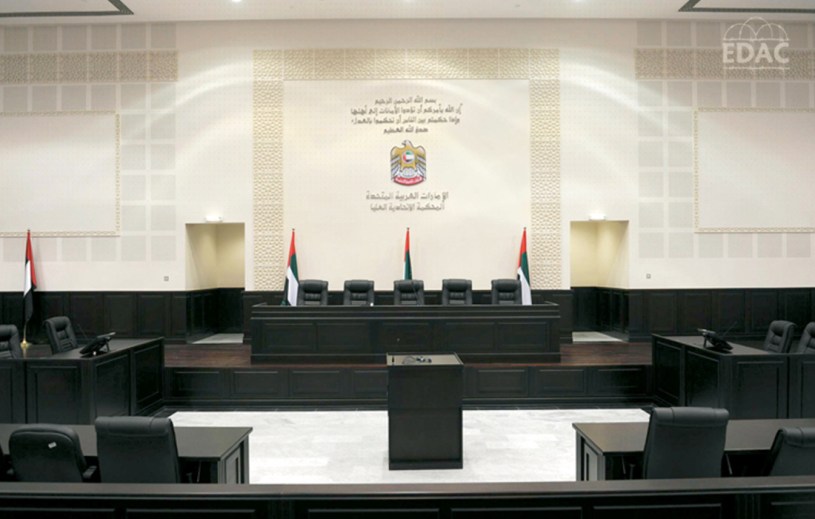
Photo credit: Blog of the Emirates Detainees Advocacy Centre (EDAC), a non-profit organization founded in 2021 by a group of human rights activists to support detainees of conscience in the UAE and shed light on their cases.
[1] Human Rights Watch, United Arab Emirates.
[2] FIDH, United Arab Emirates: criminalising dissent, UAE 94 trial deeply flawed, August 2013.
[3] ECDHR, The Verdict of the UAE84 Unlawful Trial: Another Wrongful Sentencing, July 2024.
[4] MENA Rights, The use of Munasaha “rehabilitation” centres in the United Arab Emirates, 16 June 2020.
[5] UN, United Arab Emirates: UN experts alarmed by new charges brought against civil society in UAE87 trial, press release, 19 January 2024.
[6] UN, United Arab Emirates: Experts dismayed by life sentences handed down to human rights defenders, press release, 30 July 2024.
[7] SHAHANA YASMIN, Macklemore cancels Dubai show over UAE’s role in ‘ongoing genocide and humanitarian crisis in Sudan’, The Independent, 26 August 2024.
[8] A. SELVAGGIA RINALDI, How Sudan’s RSF became a key ally for the UAE’s logistical and corporate interests, Middle East Eye, 1 September 2024
[9] The Conversation, Sudan is burning and foreign powers are benefiting – what’s in it for the UAE, 12 September 2024.
[10] UN Office for the Coordination of Humanitarian Affairs, Sudan is reeling after six months of war statement by M. GRIFFITHS, 15 October 2023.
[11] UNICEF, UN agencies warn of spiraling Sudan crisis as civilians face grave risks and famine threat grows amid access barriers, 25 October 2024.
[12] Al Jazeera, UAE denies sending weapons to Sudan’s RSF paramilitary: Report, 24 January 2024.
[13] Amnesty International, Sudan: French-manufactured weapons system identified in conflict – new investigation, 14 November 2024.
[14] D.WALSH, C.KOETTL, How a U.S. Ally Uses Aid as a Cover in War, The New York Times, 21 September 2024.
 International Law Blog
Even since the end of Second World War on 2 September 1945, establishment of the United Nations on 24 October 1945, and signing of the Universal Declaration of Human Rights on 10 December 1948, the topic of human rights has assumed a special significance in international affairs. During the Cold War, the UN members signed two separate conventions on human rights. They were – (1) International Covenant on Civil and Political Rights (ICCPR) and (2) International Covenant on Economic, Social and Cultural Rights (ICESCR). Additionally, separate treaties and protocols also exist to protect rights of women, children, refugees, and physically challenged or disabled individuals. The list of such treaties continues to expand. Protection and promotion of all these human rights can be done only if all the signatories uphold these treaties in letter and spirit. That is, however, not the case for a variety of reasons. So, concerns over violations of human rights in various jurisdictions are always there. While some of the cases are highlighted by dominant powers, others are not as it depends on their preoccupations, concerns and interests . Everybody knows that the world also grapples with many other issues, including climate change, terrorism, piracy, wars and insurgencies. Thus, priorities of nations and their policy-makers vary from time to time. Western nations- traditional defenders of human rights- today in 2024 have many other pressing concerns. International trade, foreign investment, GDP growth and overall economic development have overshadowed the discourse on human rights. Western indifference and apathy towards these matters also enfeebles international organisations raising such issues. By the way, the very definition of human rights is contentious. While cosmopolitan individuals interpret human rights as global or universal in nature, the relativists treat human rights as culture-specific. Thus, the Communist powers, autocracies and theocracies often dismiss the Western focus on individual civil and political rights, democratic governance, rule of law, free press, and independent judiciary. They emphasise group rights, economic, social and cultural rights, absolute or maximum possible state control. The plea of ‘national sovereignty’ is always there to come to rescue of all rulers. Responsibility to Protect (R2P) system of the United Nations has also been selectively used by world powers. In other words, the regimes like the UAE and many others take advantage of the contemporary international scenario. Long-term solutions to these problems lie primarily in domestic efforts and initiatives. It is in the enlightened national interest of each country and its rulers to promote and protect human rights of all. Domestic robust mechanism for protection of human rights enriches and fortifies nations as well as their rulers.
LikeLike