
Shekhar Pathak and Priyanshu Tripathi are law students pursuing their B.A. LL.B. (Hons.) at the National Law Institute University, Bhopal, India
Introduction
‘The role of the courts is especially important in the context of the protection of the environment and giving effect to the principle of sustainable development.’
Imagine Sarah, a 17-year-old climate activist from Mpumalanga, celebrating the North Gauteng High Court’s (Court) decision to halt new coal power stations, while her father, a coalmine worker for 25 years, sits quietly at their dinner table wondering about his future. This reflects the complexity of South Africa’s latest environmental milestone; the successful youth-led constitutional challenge against plans to procure 1500 megawatts (MW) of new coal-fired power stations, popularly known as the #CancelCoal initiative. As Sarah’s and her father’s contrasting reactions, this decision raises several questions: How can South Africa, one of the world’s most coal-dependent economies, transition to a cleaner future while safeguarding livelihoods? How should courts strike a balance between long-term environmental sustainability and the immediate human needs of communities dependent on coal? This article first provides a background to the case, then critically analyses the implications of the decision on different stakeholders. Secondly, it proposes key reforms to help courts better navigate these complex disputes, where sustainable development must balance environmental protection with human needs.
Case Background
In 2021, the Centre for Environmental Rights, on behalf of the African Climate Alliance, Vukani Environmental Justice Movement, and Groundwork—organizations advocating for environmental justice—filed an application in the High Court of South Africa challenging the government’s decision to add 1,500 MW of coal power stations in its 2019 Integrated Resource Plan (IRP). The applicants argued that the IRP violated Section 24 of the Constitution, which guarantees the right to a healthy environment, and Section 28(2), which prioritizes the best interests of children. Also, they presented expert evidence highlighting renewable energy as a cleaner, more cost-effective alternative essential for reducing emissions and protecting vulnerable populations, particularly children, in line with the State’s constitutional obligations. And, upon reviewing the evidence, the court identified several deficiencies in the government’s process, including inadequate public participation and insufficient justification for deviating from earlier proposals. It emphasized that the IRP must comply with constitutional obligations under Sections 7(2) and 8(1), which require the State to uphold the Bill of Rights and act lawfully. Consequently, the failure to adequately assess environmental impacts and consider the welfare of children was deemed a violation of constitutional principles, leading the court to declare the proposal unlawful and invalid with respect to the addition of coal power stations.
Analysis: What is the problem?
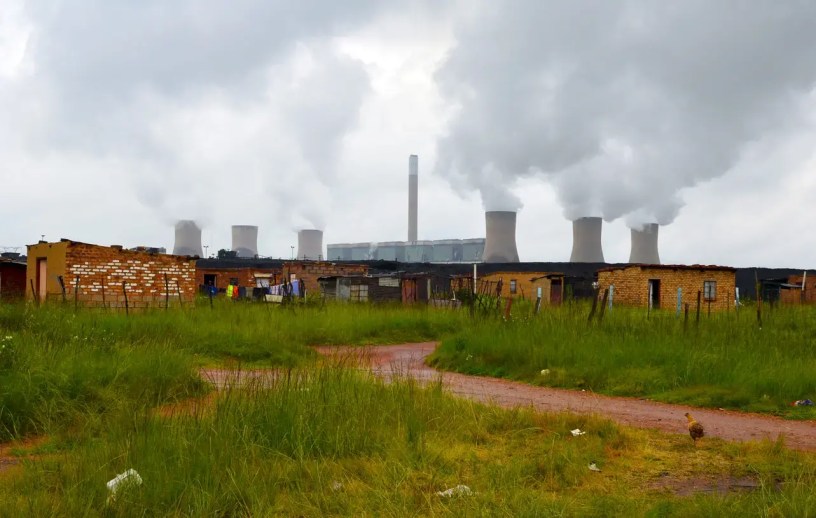
The story of coal in South Africa is not merely statistical; it is deeply human. Coal remains the cornerstone of the nation’s energy sector, generating 75% of its electricity, while renewable sources account for just 7.4%. In fact, Africa’s largest coal producer and home to the world’s fifth-largest recoverable reserves, South Africa’s relationship with coal goes beyond resource extraction—it is intertwined with community survival. This heavy reliance on coal has shaped South Africa into what experts term a “coal-dependent development” country. However, the court’s recent decision highlights a critical reality: transitioning away from coal is far more complex than merely implementing policy changes. It requires addressing the lives of mining communities, power plant workers, and families who have built their futures around this industry. The challenges include:
- Economic Dependency on Coal
Firstly, coal plays a crucial role in South Africa’s economy, particularly in the Mpumalanga province, where it serves as a cornerstone of survival. It contributes 20% to the region’s economy, with municipalities like Emalahleni, Msukaligwa, Steve Tshwete, and Govan Mbeki relying on coal for up to 42% of their economic activity. And, approximately 85% of employment in Mpumalanga is tied to coal. But, behind these statistics lies a stark reality: 34% of Mpumalanga’s residents struggle to afford basic food, while 22% live below the international poverty line. Consequently, disrupting the coal value chain, which is vital to these regions, could lead to severe economic consequences.
- Internal Political Challenges
Secondly, as the world’s most unequal country, South Africa’s energy transition mirrors its broader social challenges, where workers and labour unions often struggle to find their voice in energy policy decisions. This inequality came to life in 2017 when coal truck drivers, facing the threat of losing their livelihoods, took to the streets of Tshwane in protest against coal plant closures. These grassroots tensions continue to shape the nation’s complex path toward energy transition. In India, the Supreme Court in M.C. Mehta struck a balance by acknowledging the risks posed by such industries while rejecting the notion of shutting them down completely. It emphasized the need to balance economic necessity with environmental concerns. However, in the present case, the Court’s reasoning primarily focuses on the potential harm the proposed IRP could cause to children and the environment. Yet, in towns where coal provides livelihoods and sends children to school, the absence of clear transition guidelines leaves communities uncertain about their future.
- Problematic Transition
Lastly, South Africa finds itself at a precarious energy crossroads, where any hasty transition away from coal, without a comprehensive alternative strategy, risks plunging the nation deeper into crisis. The current reality is already evident, as daily power deficits of 4,000 to 6,000 MW force citizens to endure blackouts lasting up to 10 hours, turning daily life into a constant struggle. These are not merely inconvenient interruptions; they threaten both economic stability and basic safety, with increased risks of residential fires as people seek alternative heating and lighting solutions. Eskom, the state utility giant, whose 14 coal-fired power stations form the backbone of the nation’s power supply, generates 80% of its electricity. Yet, these aging facilities, increasingly prone to breakdowns, represent both the nation’s lifeline and its vulnerability. The Court’s decision, while environmentally conscious, overlooks a crucial question: how will millions of South Africans maintain their daily lives during this transition? The gap between current reality and future aspirations cannot be bridged by good intentions alone; it requires practical solutions for the immediate energy security needs of citizens.
Proposals and Conclusion
Over time, South Africa’s judiciary has shown remarkable growth in environmental protection, from recognizing air pollution as a constitutional violation in EarthLife Africa to respecting Indigenous voices by halting seismic surveys in South African communities. In fact, through cases like Concorde Plastics and Nedbank, courts have opened their doors wider to those who traditionally struggled to access justice. Despite this, as our analysis observed, the present decision highlights three key issues: first, the unavoidable reality of coal dependency despite its environmental cost. Second, the current courts’ limitations in balancing competing interests, and third, the intricate challenge of pursuing sustainable development—comprising three interconnected pillars, intertwined with systems dynamics. To address these gaps, we propose three key judicial reforms:
- Balanced Approach
At the heart of any nation’s sustainable development lies effective governance, anchored in the rule of law. And, for the rule of law to be effective, compliance and enforcement are essential. However, in this context, the judiciary plays a crucial role in ensuring adherence to environmental protections, while this responsibility must also be balanced with respect for the government’s prerogative to shape economic policy, particularly in emerging economies like South Africa. But, this is not an easy task, as: first, the complexity of the issues and the differing impacts on various groups makes it harder to find this compromise. Second, policymakers may often fail to forge consensus, and lastly, courts, despite their authority, frequently lack the perspective and resources needed for definitive resolutions. The Supreme Court of India, in M.K. Ranjitsinh, addressed this critical challenge by balancing the conservation of the Great Indian Bustard (GIB), whose decline is attributed to habitat loss and transmission lines, with India’s renewable energy goals. Recognizing the difficulties posed by underground transmission lines, the Court revised its earlier order to uphold protections for critical habitats while ensuring that its broader directives were practical and implementable. South Africa faces a similar balancing act: meeting ambitious greenhouse gas reduction targets while ensuring energy security for its people. Hence, this is not just about numbers; it is about finding ways to protect both the environment and the future of communities.
- Merit-Based Review
The current preference for judicial review over merit-based assessment has created a troubling pattern in South African environmental disputes. When courts prioritize procedural compliance —ensuring administrative actions follow proper protocols—they often sidestep the heart of environmental concerns. This case clearly illustrates this dilemma, where discussions about proper public consultation overshadowed the actual environmental impact at stake. Similarly, in Earthlife Africa, the court deferred substantive safety concerns to the National Nuclear Regulator, reflecting a lack of direct engagement with the core environmental issues. Instead, the court focused on administrative law, holding that the applicant had not been allowed to address new facts in the environmental impact report. Conversely, a merit-based review process offers a more promising path forward, allowing courts to craft meaningful guidelines that could shape future administrative decisions and strengthen environmental protection. Even, South African courts have shown they can adapt their approach when needed, as evidenced in cases like Rivonia Primary School, where procedural fairness became a pivotal issue despite not being raised in initial pleadings and KwaZulu-Natal Joint Liaison Committee, where the court demonstrated flexibility by making substantive decisions despite procedural gaps. This judicial adaptability could transform environmental protection if redirected toward addressing core environmental issues, moving from procedural box ticking.
- Dedicated Environmental Court (DEC)
When environmental disputes arise between citizens and authorities, courts often serve as the final resort for justice. India’s Supreme Court captured this essence in Tarun, noting “Government over big business, individual liberty over government, and environment above all.” Yet, the complexity of environmental cases demands more than traditional judicial wisdom and requires specialized expertise that general courts typically lack. In fact, various reports, commentaries, and judgments such as, M.C. Mehta, M.V. Nayudu, and Enviro- Legal Action have consistently advocated for specialized environmental courts. These courts, tailored to resolve such disputes, integrate scientific knowledge and technical expertise into the judicial process and, in turn, enhance their legitimacy, yielding better environmental outcomes. Moreover, in developing nations, such courts have proven particularly valuable in giving voice to citizens, NGOs, and disadvantaged groups. Take Kenya’s Environment and Land Court in Mombasa in Kelvin Musyoke, where it upheld the Owino Uhuru community’s right to a healthy environment.
Furthermore, to address whether such courts can be established under the South African Constitution, Section 166(e) provides for such innovation, enabling the creation of specialized courts with equivalent status to High or Magistrates’ Courts. In fact, the country’s brief but promising experiment with the Hermanus Environmental Court in 2003 highlights this potential. Notably, its track record was impressive: a striking 70% conviction rate in its first year, rising to 80% within 30 months. Also, Snijman’s analysis reveals its broader impact: first, its meticulous evidence handling that closed technical loopholes. Second, increased public environmental awareness, strengthened anti-poaching efforts, and lastly, achieved genuine deterrence through consistent enforcement. Yet despite these successes, political decisions led to its closure in 2007—a stark reminder that institutional innovation needs robust legislative protection. This need becomes even more pressing given South Africa’s deep reliance on coal for its energy security. Hence, the country requires courts that can thoughtfully weigh both environmental protection and development imperatives, as their decisions ripple through the nation’s economic fabric.
Image by Mark Olalde (South Africa, 2017) at Pulitzer Center
 International Law Blog