
Marielys Padua Soto is a multilingual lawyer and humanitarian professional with a strong passion for addressing the challenges endured by refugees, migrants, and Indigenous peoples.
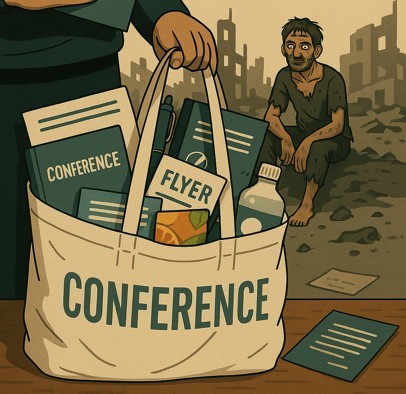
I recently attended a humanitarian conference centered on a protracted crisis. The panels were well-curated, the keynote speakers impressive, and the venue state-of-the-art. I walked away with new insights — and a tote bag stuffed with branded notebooks, high-quality pens, logo-embossed water bottles, stickers, and flyers. It was all very well-organized and thoughtful, down to the sustainably sourced snacks and the eye-catching photo booth designed for social media engagement. And yet, as I sifted through these tokens of participation, I couldn’t silence a question echoing through my mind:
Why was this money not spent on the actual victims of the crisis?
This question, which may sound overly simplistic or even unfair to some, is not rooted in cynicism. It emerges from a growing discomfort with the paradoxes embedded in the professionalization of humanitarianism. Conferences like these are often organized in the name of solidarity and advocacy. But they also reflect a performance of concern, one that can sometimes feel uncomfortably detached from the raw, ongoing emergencies we are supposedly gathered to address.
This isn’t a call to dismantle academic or policy-oriented convenings. Many conferences offer valuable spaces for learning, cross-sectoral dialogue, and collective strategizing. But we must hold space for a deeper interrogation:
What kind of humanitarianism are we performing when swag bags and social capital appear more tangible than outcomes for those we claim to serve?
The Spectacle of Suffering
The humanitarian sector has always straddled an uneasy line between care and performance. As the field has professionalized over the past few decades, so too has its infrastructure: glossy reports, interactive dashboards, organizational branding, and yes, conferences with catered lunches, color-coded lanyards, and cocktail receptions.
At one level, these elements serve important logistical and communicative purposes. At another, they become signifiers of a troubling trend: the commodification of suffering for institutional gain. That tote bag, branded with the logo of an international NGO, becomes not just a functional object but a marketing tool, a subtle advertisement of presence and power in humanitarian spaces. This symbolic economy raises a fundamental question:
Who is the primary audience for these performances of concern?
Is it the displaced family in a refugee camp, the stateless mother struggling to register her newborn, or the donor, the policymaker, the career professional seeking publication or promotion?
The answer is rarely straightforward. But too often, the affected populations themselves remain invisible, not just in physical presence, but in decision-making, resource allocation, and narrative framing.
Of course, the counterargument is immediate and familiar: Event budgets are not fungible. The money used for advocacy and academic engagement cannot simply be redirected toward food aid or medical supplies. In most cases, this is technically true. Funding streams are bureaucratically compartmentalized, restricted by donor requirements, institutional mandates, and thematic portfolios. But recognizing this doesn’t fully address the moral tension. When we accept these partitions without critique, we risk normalizing a system in which institutional visibility can appear more valuable than human lives.
For instance, some conferences spend thousands on audiovisual production to ensure panels are recorded in high definition. Meanwhile, grassroots organizations on the ground, often composed of displaced people themselves, struggle to keep the lights on. Catering services are contracted to serve quinoa salads and smoked salmon, while the communities being discussed survive on food rations that are repeatedly slashed due to funding shortfalls. It’s not that we must choose between effectiveness and ethics. It’s that we must constantly evaluate whether our processes are aligned with our purported goals.
Are our conferences sites of transformation or replication?
Who Gets to Speak?
The humanitarian sector often claims to center affected communities, yet this commitment rarely translates into equitable participation. How many panels feature refugee or displaced speakers, not as token survivors, but as intellectual equals, strategists, researchers, or leaders?
Barriers to participation abound: visa restrictions, language limitations, lack of travel funding, and security concerns. But more insidious is the unspoken assumption that expertise resides in those who write policy briefs, not in those who have lived the consequences of those policies.
This dynamic mirrors a broader colonial residue in the sector, where knowledge flows from the Global North to the Global South, and legitimacy is granted through degrees and institutional affiliations rather than lived experience. It is not enough to invite a refugee speaker to open a plenary session.
Inclusion must be structural, not symbolic.
Conferences as Safe Spaces for Professionals
One of the ironies of humanitarian conferences is that while they often center suffering, they are typically designed as comfort zones for professionals. The venues are clean, safe, and sanitized. The atmosphere is collegial, polite, sometimes even celebratory. This comfort is not inherently wrong. After all, those working in crisis response need time to process, learn, and build alliances. But the stark contrast between the comfort of the conference and the violence of the crisis can create cognitive dissonance, especially when the latter is evoked through carefully curated language, emotional testimonials, or graphic imagery.
Beyond the physical and emotional comforts of these spaces, many professionals take these opportunities to travel and engage in a bit of tourism. Conferences are often held in major cities, hubs of international connectivity with rich histories, vibrant food scenes, and tourist attractions. It is not uncommon to see social media posts from attendees who, after speaking on panels about famine, displacement, or mass atrocities, are sipping wine at rooftop bars, exploring ancient ruins, or posting selfies with picturesque backdrops. These moments of leisure are not inherently unethical (burnout is real, and people are entitled to enjoyment) but they reveal the uncomfortable duality of the humanitarian world: the ability to shift quickly between witnessing suffering and indulging in privilege.
There is a risk that these gatherings become echo chambers, spaces where suffering is aestheticized, abstracted, and ultimately metabolized into professional capital. Academic institutions and NGOs may produce policy papers, op-eds, or project proposals rooted in the conference’s themes.
But what accountability mechanisms exist to ensure that these outputs benefit those who inspired them?
Let’s not forget that humanitarian conferences are also spaces of career-building. The coffee breaks are strategically long to facilitate networking. Many participants arrive with business cards, CVs, or LinkedIn QR codes at the ready. Panels are often more about who is on them than what is said. Again, there is nothing inherently wrong with building connections in shared spaces. In fact, much of the humanitarian sector thrives on personal networks. But it is worth asking:
Do these rituals of networking enhance solidarity or reinforce elitism?
When a young researcher from the Global South is unable to attend a conference because of visa issues or lack of funding, their absence is not just unfortunate, it is political. It signals who gets to build knowledge, who gets to shape narratives, and who gets left behind.
Toward an Ethic of Discomfort
So where does this leave us?
If we accept that humanitarianism is a field full of contradictions, then our task is not to retreat in guilt or defensiveness. It is to sit with the discomfort, to let it inform our decisions, and to remain vigilant against the temptations of convenience, spectacle, and self-congratulation.
We must learn to ask hard questions in soft spaces:
- What would this panel look like if those being spoken about were the ones leading it?
- How can we ensure that our advocacy doesn’t end with applause?
- What does it mean to be in solidarity, not just symbolically, but structurally?
We also need to build transparency into our practices. If a conference costs $100,000, can the organizing institutions also commit a percentage of that to fund grassroots actors from the affected region? Can conference materials include budgets alongside schedules, to prompt collective reflection on priorities?
Conclusion: From Performance to Praxis
Humanitarian conferences are not inherently flawed. They can catalyze policy change, incubate partnerships, and nurture solidarity. But they are also vulnerable to becoming sites of performance, where the image of care eclipses its reality. To move from performance to praxis, we must redesign these spaces, not just their budgets and branding, but their very purpose. This means centering those most affected, not as objects of compassion but as agents of change. It means treating discomfort not as a failure of hospitality but as a sign of ethical growth.
At the heart of humanitarianism lies a simple but profound truth: our responsibility to one another must transcend institutional mandates, professional rituals, and aesthetic gestures. If our conferences do not reflect that truth, if they do not embody it in both form and function, then they are not humanitarian at all. They are just another industry event.
Let us do better. Let us ask more. And let us not confuse swag with solidarity.
 International Law Blog
The Customary International Law Principle of Due Diligence in Preventing Acts of Terrorism
The duty of states to prevent their territory from being used for terrorist acts against other states is a well-established principle in international law, stemming from various sources, including customary international law, UN General Assembly resolutions, and binding Security Council resolutions.
Customary International Law (Principle of Due Diligence) :
This principle dictates that a state must not allow its territory to be used for acts contrary to the rights of other states. In the context of terrorism, this means a state has a duty to take all reasonable and feasible measures to prevent non-state actors operating from its territory from carrying out terrorist acts against other states.
The International Court of Justice (ICJ) in the Nicaragua v. United States case (1986) affirmed the principle that states have a duty not to allow their territory to be used for activities that harm other states, even if they don’t have effective control over the non-state actors themselves. This duty is often referred to as the “due diligence” obligation. It means a state cannot simply tolerate or acquiesce in such activities.
Binding UN Security Council resolutions, particularly Resolution 1373, which explicitly obliges states to deny support and safe haven to terrorists and prevent the use of their territory for terrorist acts.
Hence, any state could be “tolerating” or “acquiescing” in terrorist activities by failing to take reasonable preventative measures also constitutes a violation of international law due to the state’s due diligence obligation.
In the case of India’s Pahalgam response & October 7, sufficient authorities have determined that the states used as launchpads from which the acts of terrorism had originated from, have likely violated international law due to the state’s due diligence obligation.
The duty of states to prevent their territory from being used for terrorist acts against other states is a well-established principle in international law.
It is the state’s responsibility to undertake all reasonable and feasible measures to prevent non-state actors operating within its borders from carrying out terrorist acts against other nations.
LikeLike
Thanks a lot to Marielys Padua Soto for being so outspoken. This conference industry scenario surrounding humanitarian sector (and others too such as environment, poverty, SDGs) reminds one of a famous statement, “Hypocrisy, thy name is civilisation”. If the original purpose behind having conferences was to dovetail intellectual and real-life concerns so as to do empirical evidence based policy-making, today the ground reality is otherwise. Very often, it is an exercise in intellectual catharsis. It is customary for professionals to pay lip service to lofty ideals and shed crocodile tears for those in miserable conditions. While NGOs may be using these conferences to get funding for the projects, researchers tend to use these as career advancement opportunities. Publishers look for new publication avenues. Is it possible for diverse stakeholders to be mindful of the rationale behind the conference world and live up to those cherished ideals? Doing so will make it a meaningful exercise, enhance their reputation and help transform the world. A drop in the ocean too matters a lot. Each baby step is as important as a giant leap. Rome was built in a day.
LikeLike