
Introduction
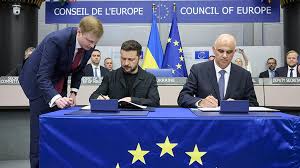
On 25 June 2025 the Secretary General of the Council of Europe (CoE), Alain Berset, and the President of Ukraine, Volodymyr Zelenskyy, signed in Strasbourg (France) an agreement to establish the Special Tribunal for the Crime of Aggression against Ukraine. The tribunal, expected to be operational in 2026, aims at trying senior political and military leaders responsible for the aggression committed against Ukraine since February 2022.
The agreement recalls all relevant resolutions adopted by the UN General Assembly since 2014, the Charter of the International Military Tribunal adopted on 8 August 1945, and the amendment to the Rome Statute establishing the International Criminal Court (ICC), adopted on the occasion of the very first Review Conference of the Statute held in Kampala (Uganda) in 2010, and providing for a long-awaited definition of the crime of aggression.
As clarified by the Parliamentary Assembly of the CoE in its Recommendation 2294 (2025) of 9 April 2025, the agreement is open to CoE member states, observer states and non-members of the CoE, including other international organisations. The Statute of the Tribunal comes as result of the work of the so-called Core Group on the Establishment of a Special Tribunal for the Crime of Aggression against Ukraine. It was then Ukraine who requested the establishment of the tribunal by a letter sent to the Secretary General of the CoE on 13 May 2025. The CoE Committee of Ministers, on 4 June 2025 at the 1530th meeting of the Ministers’ Deputies decided to set up a Working Party on the Special Tribunal for the Crime of Aggression against Ukraine (GT‑TRIBUNAL), open also to observer States, as well as the European Union, with the mandate to examine the draft legal instruments submitted by Ukraine and to prepare the decisions required to establish the Special Tribunal within the framework of the Council of Europe.
According to article 1 of the Special Tribunal’s Statute, the tribunal’s jurisdiction is based on Ukraine’s territorial jurisdiction. This post aims at providing a preliminary commentary on certain peculiar aspects of the newly-established tribunal, by comparing its Statute with the ICC Statute and its relevant provision, namely, article 8bis.
One, Two, Many Definition(s) of Aggression?
The definition of the crime of aggression adopted in Kampala in 2010 was celebrated as a diplomatic success as it came after decades of very difficult negotiations, which had been negatively impacted by the Cold War logics both within and without the United Nations Organisation. The potential of the Kampala amendment has been however regrettably diminished by the Assembly of States Parties’ decision to activate the jurisdiction of the Court adopted in December 2017, as it limits the Court’s jurisdiction just to cases of aggression committed by states parties that have ratified the relevant amendment against the territorial integrity or political independence of another state party that has ratified the amendment. Hence, notwithstanding the fact that Ukraine has joined the ICC Statute, including the amendment on the crime of aggression, on 1 January 2025, the ICC cannot exercise jurisdiction on the alleged crime of aggression committed against Ukraine.
The agreement acknowledges this limitation, but the Statute makes it clear that the Tribunal wants to be complementary to the ICC. According to article 46(2), in fact, ‘[n]othing in this Statute shall negate the existing obligations of States Parties to the Rome Statute of the International Criminal Court to co-operate fully with the International Criminal Court in its investigation and prosecution of crimes within its jurisdiction’. The Statute also includes a non-prejudice clause as under article 5 ‘[n]othing in this Statute shall be interpreted as limiting or prejudicing in any way existing or developing rules of international law for purposes other than this Statute’. As argued by Prof Schabas in relation to the effects of a similar clause contained in the ICC Statute (i.e., article 10 ICC Statute), however, I find unconvincing that a multilateral agreement involving several states and possibly non-state actors, regulating one of the most fundamental aspects of the system established by the UN Charter, to which it makes express reference, can have no effects on the development of the international law rules governing the crime of aggression.
If one assumes that the existing customary rule criminalizing aggression constitute a jus cogens rule, then it could only be modified by another jus cogens rule (see, in this respect, the ILC’s 2022 Draft Conclusion 6(2)), which is not easily achieved. Therefore, my main concern revolves around the still-developing rules on the crime of aggression. In other words, the definition contained in the Statute of the newly established Special Tribunal might affect such customary definition if this, contrary to what I have argued elsewhere– is still in the process of crystallising.
It is noteworthy that, notwithstanding the express deference to the ICC, its Statute and the crime of aggression as defined under article 8bis ICC Statute, the Statute of the Special Tribunal presents some peculiarities that do not align with the ICC rules. At times this could be a progressive development compared to the Rome Statute and arguably the corresponding customary rule, but in some other cases it could actually constitute a regression vis-à-vis the rules established under the ICC Statute.
An Analysis of the Definition of Aggression Contained in the Statute
The definition of aggression provided by the Statute of the new Special Tribunal pays significant tribute to the Kampala definition. Article 2 paragraphs 1 and 2 are indeed taken verbatim from article 8bis and they read as follows.
For the purpose of this Statute, “crime of aggression” means the planning, preparation, initiation or execution, by a person in a position effectively to exercise control over or to direct the political or military action of a State, of an act of aggression which, by its character, gravity and scale, constitutes a manifest violation of the Charter of the United Nations.
For the purpose of paragraph 1 of this article, “act of aggression” means the use of armed force by a State against the sovereignty, territorial integrity or political independence of another State, or in any other manner inconsistent with the Charter of the United Nations.
Yet paragraph 3 diverges from the ICC definition as while it mentions the UN General Assembly resolution 3314(1974)containing the consensus definition of aggression, it does not incorporate the non-exhaustive list of examples of acts of aggression provided by article 3 of the resolution 3314. Moreover, this resolution is not the only one expressively referred to in article 2 (3) of the Statute of the Special Tribunal. Rather, ‘[f]or the purpose of determining whether an act of aggression, by its character, gravity and scale, constitutes a manifest violation of the Charter of the United Nations, the Special Tribunal shall [also] take into account (…) all relevant United Nations General Assembly resolutions with respect to Ukraine, including those recited in the preamble of the Agreement between the Council of Europe and Ukraine on the Establishment of the Special Tribunal for the Crime of Aggression against Ukraine’. These are Resolution A/RES/68/262 of 27 March 2014; Resolution A/RES/71/205 of 19 December 2016; Resolution A/RES/73/194 of 17 December 2018; Resolution A/RES/76/70 of 9 December 2021; Resolution A/RES/ES-11/1 of 2 March 2022, which is the first one clearly referring to an aggression and, notably, deplored the involvement of Belarus; Resolution A/RES/ES-11/6 of 23 February 2023; Resolution A/RES/79/184 of 17 December 2024, which condemned the war of aggression against Ukraine.
Indeed, according to paragraph 4 of article 2 of the Statute of the Special Tribunal adds ‘[f]or the purpose of this Statute, in the context of the aggression against Ukraine, an act of aggression which is determined by its character, gravity and scale to constitute a manifest violation of the Charter of the United Nations, shall also be deemed to constitute a war of aggression’. This is an important difference with the ICC definition, which only refers to an act of aggression. While it is uncontroversial that certain acts of aggression can overlap or coincide with a war of aggression, it is important to note that the ICC Statute provides individual criminal responsibility for those political or military leaders of an aggressor state when they commit an act of aggression. In this respect, the definition provided by the Statute of the Special Tribunal may well constitute a regression to the Nuremberg time, when article 6a of the IMT Charter only criminalised aggressive wars. Although the judgment also concerned certain acts of aggression, including the occupation and annexation of Austria prior to the beginning of the Second World War which did not see any armed resistance by the latter, it should be stressed that at that time the UN Charter had not yet impacted on the international customary norms relating to the ius ad bellum and, through it, on the crime of aggression.
Lastly, the Special Tribunal may expand the category of individuals susceptible of being prosecuted. Unlike what is provided by the Rome Statute, where the Court could only prosecute the political or military leaders of the state committing the act of aggression, the newly established tribunal might also prosecute Belarusian or North Korean individuals, ‘if evidence shows they played a significant role in the crime of aggression against Ukraine’. In other words, political and military leaders of states other than the aggressor, may well be considered responsible for the crime of aggression, hence in so doing weakening the link between the individual act and the act of the state, which is a key feature of the Kampala definition.
Conclusion
The newly-established Special Tribunal for the Crime of Aggression against Ukraine may well constitute an attempt to circumvent the limits and shortcomings of the ICC Kampala definition of aggression, especially with respect to the Court’s ratione personae jurisdiction.
Yet, the definition of aggression contained therein might impact on the customary definition of the international crime of aggression, if this is still in the process of crystallization. While the reference to the UN Charter in both definitions may grant coherence and avoid inconsistencies, the use of the ‘Nuremberg concept’ of ‘war of aggression’ alongside the ‘act of aggression’, seems to be anachronistic and raises concerns about the possible future effects of such a treaty-based definition.
It will be up to the Tribunal, if one or more judgements are ever issued, to clarify these definitional issues to align its Statute to the ICC precedent and the related customary rules.
 International Law Blog
Thank you for this post. I am yet unclear about what is the exact (positive, negative or intended) effect of including the additional qualification of “war of aggression”. Is it perhaps only to (1) mirror the language of GA Res. 79/184; and/or (2) signify the ongoing nature of hostilities and the application of IHL?
LikeLike
It is worrying to see there is no consensus on definition of aggression. This subjectivity also affects determination of who is an aggressor and who is a victim. International law seems to be more interested in perpetuating controversies than in rendering justice.
LikeLike