
By Omar Khoury
On September 9, 2025, Israel executed a series of airstrikes targeting a meeting of senior Hamas political figures in Doha, Qatar.[1] Israel’s attack has been denounced—in artfully worded condemnations exhausting the inexhaustible thesaurus—as a flagrant violation of international law and Qatari sovereignty.[2] However, two other States appear to have been implicated in Israel’s act of aggression against Qatar, even if unintentionally so.
The ballistic missiles were fired from F-15 and F-35 warplanes, both of which were produced and provided by the United States.[3] The missiles were fired from the Red Sea and flew hundreds of miles over the air-defense-studded airspace of Saudi Arabia and onto their intended targets in Qatar.[4]
Under these facts, and assuming that Saudi Arabia had the capability to shoot down the Israeli missiles or the warplanes, the attack appeared to have triggered Saudi Arabia’s entitlements and manifested the United States’ obligations. What were the international legal rights and duties of these third-party States arising out of Israel’s use of force against Qatar? The answer lies in the distinction between a State right (an entitlement to act or to refrain from action) and a State duty (an obligation to act or to refrain from action).
Saudi Arabia and the Right to (Collective) Self-Defense
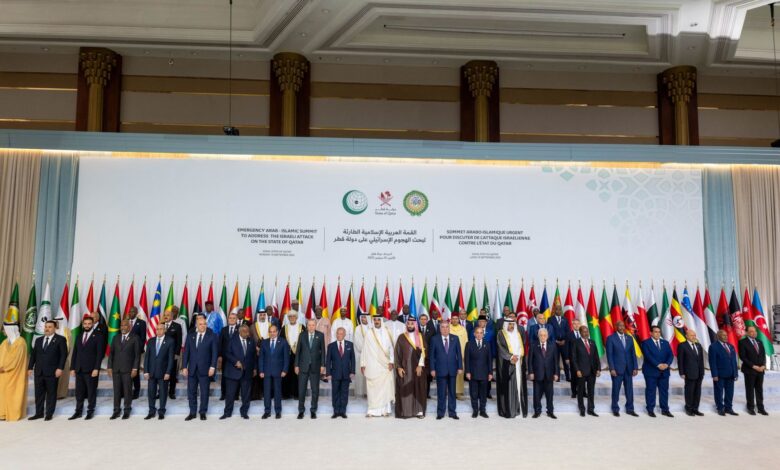
As is often the case with many countries, rhetoric does not resemble reality. The Communique issued by Arab-Islamic Emergency Summit in Doha on September 15, 2025 provides a clear illustration. The withered extent of the response from the convention of dozens of heads of state following the Israeli airstrikes was the mere issuance of a stentorian proclamation “[r]eaffirming [the] unwavering commitment to the sovereignty, independence, and security of all Member States … and recalling [the]collective duty to respond to this aggression in defense of … common security.”[5]
Puzzlingly, the adoption of this Communique may have unintentionally indicted Saudi Arabia for its inaction in the face of its apparent “duty to respond to [the Israeli] aggression in defense of … common security.”
Indeed, if the presumption is that international law imposes a duty upon a State (Saudi Arabia) to intervene when its territory is used by another State (Israel) to facilitate an armed attack on its neighbor (Qatar), then Saudi Arabia appeared to have violated this duty by refraining from shooting down the Israeli projectiles sailing through its airspace. The working assumption here, of course, is that Saudi Arabia had the ability to shoot down the ballistic missiles. Indeed, Saudi Arabia boasts an extensive array of state-of-the-art ballistic missile defense and air defense capabilities.[6] It is also believed to be a member of the U.S.-led Middle East Air Defense Alliance (MEAD) and helps constitute a vast and advanced regional missile defense network.[7]
Nonetheless, and contrary to the colorful language of the Communique, a State has no international legal duty to intervene in collective self-defense or self-defense vis-à-vis third States where an aggressor State uses the neutral State’s territory against its consent.
The Legal Framework of the Right of Self-Defense and Collective Self-Defense
Article 51 of the United Nations Charter provides an exception to the prohibition on the use of force as outlined in Article 2(4) thereto. The exception codifies the “inherent right of self-defense or collective self-defense if an armed attack occurs against a Member of the United Nations ….”[8] That exception animates what is expressly identified as an individual State right arising from the collective State duty to refrain from the use of force.
Further, the commentaries to the draft articles on the Responsibility of States for Internationally Wrongful Acts (“RSIWA”), adopted by the International Law Commission at its fifty-third session in 2001, re-affirm the characterization of self-defense vis-à-vis third States as permissive, not mandatory. Article 21, which licenses “self-defense taken in conformity with the Charter of the United Nations …[,] leaves open all issues of the effect of action in self-defense vis-à-vis third States.”[9] Even when contemplated by treaty drafters, public international law does not give rise to a duty for a State to intervene in defense of another State during hostilities that implicating the neutral State.
That international law dispels intervention does not mean that States have no duty to engage in acts in defense of other States. Rather, such obligations are better analyzed in relation to mutually agreed-upon bilateral agreements concerning military or defensive alliances. These agreements historically provide the binding obligation for a State to intervene in defense of another State as is expressed in Articles 34 and 35 the Vienna Convention on the Law of Treaties.[10], [11] Even so, Qatar and Saudi Arabia are members of the Gulf Cooperation Council, but there is no indication that the two have entered into a mutual-defense agreement authorizing intervention on the other’s behalf.
Instead, the propriety of Saudi Arabia’s inaction centers on what entails an international legal “right of intervention” into another State’s internal affairs. Such a right is set forth—and is severely curtailed—in Chapter VII of the UN Charter. Ultimately, the UN Security Council is enfranchised with this right, as only the UNSC can determine whether a State’s behavior is a threat to international peace and security.[12] Even to the extent that a State can exercise its “inherent right of individual or collective self-defense,” Article 51 provides that those measures still “shall be immediately reported to the Security Council and shall not in any way affect the authority and responsibility of the Security Council….”
Thus, while Saudi Arabia may have been entitled to intervene and intercept the Israeli missiles pursuant to its right to self-defense and collective self-defense, the exercise of this right is expressly limited and remains discretionary. Saudi Arabia may indeed invoke the general interest of maintaining or restoring international peace and security as a pretext or justification for intervention, but that interest alone does not mandate its action. At bottom, though it had a right to, Saudi Arabia had no duty to intercept the Israeli ballistic missiles sailing through its airspace.
The United States and the Duty of Abstention: Non-Recognition and Non-Assistance
While the attack on Qatar provided Saudi Arabia with an entitlement to act, it nevertheless demanded of the United States an international legal obligation to abstain. This obligation is two-fold: first, a State must not recognize as lawful situations created by serious breaches (the duty of non-recognition), and, secondly, a State must not render aid or assistance in effectuating or maintaining that situation (the duty of non-assistance).
Notably, the United States appears to have abided by the former, but it nevertheless violated the latter.
As it relates to the duty of non-recognition, the United States joined in on a non-binding UN Security Council press statement that condemned the strikes on Qatar.[13] Though the innocuous statement did not mention Israel, it ostensibly fulfills the requirement that States not recognize the validity of an aggressor State’s illegal conduct.
The United States’ culpability is more apparent as it relates to a breach of the State duty of non-assistance. In an interview on September 17, 2025, United States Ambassador to Israel Mike Huckabee disclaimed that America was “a part of the [Israeli airstrikes on Qatar]” and submitted that it was “not something [America] can be held responsible for.”[14] But although no American pilot was a part of the operation, the same cannot be said about the American munitions and warplanes.
Assuming the United States was not informed of the strike ahead of time, can the argument still be made that the United States’ provision of weapons and warplanes to Israel—especially where it was reasonably foreseeable that Israel would violate international law in using them—constitutes a violation of the international legal duty of non-assistance?
This answer depends on the scope of the timeline being drawn.
The Legal Framework of the Duty of Non-Assistance
The obligation of non-assistance mandates that a State not render aid or otherwise abet another State in facilitating the commission of an internationally wrongful act by the latter.[15] Under RSIWA Article 16, a State “which aids or assists another State in the commission of an internationally wrongful act by the latter is internationally responsible for doing so if: (a) that State does so with knowledge of the circumstances of the internationally wrongful act; and (b) the act would be internationally wrongful if committed by that State.”
The RSIWA commentaries expound upon the three critical elements—conversely known as limitations—to a claim of a breach of non-assistance: knowledge, causation, and the inherent wrongfulness of the act.
First, as to knowledge, a State must not “knowingly provid[e] an essential facility or financing [of] the activity in question.”[16] This individualized and fact-intensive inquiry centers upon a State’s awareness of the circumstances that make the discrete act wrongful. It does not focus on whether the assisting State has knowledge that the aggressor State is a serial violator of international law. Rather, knowledge is specific as to the wrongfulness of the particular act in question.
Second, as to causation, a State is not internationally responsible unless it “intended, by the aid or assistance given, to facilitate the occurrence of the wrongful conduct, and the internationally wrongful conduct is actually committed by the aided or assisted State.”[17] Though the aid need not have been essential to the offense, it is nonetheless sufficient if the assisting State “contributed significantly” to the consummation of the offense. This element is inherently “after the fact,” meaning that an assisting State can only be internationally responsible once the act occurs—not for an unmanifested offense. Moreover, in cases where that internationally wrongful act would clearly have occurred in any event, liability does not extend to the assisting State.[18]
Third, the “inherent wrongfulness” of the act means that Article 16 prohibits the aiding or abetting in the breach of international obligations by which the aiding or abetting State is itself bound. It is necessary for the legal culpability of an assisting State that the conduct in question, if attributable to the assisting State, would have by itself constituted a breach of its own international obligations.[19]
For example, Germany was alleged to have participated in an armed attack by allowing United States military aircraft to use airfields in its territory in connection with the United States intervention in Lebanon in the 1980s.[20] Denying that its assistance necessarily qualified as intervention, Germany nevertheless conceded that the act of placing its own territory at the disposal of another State in order to facilitate the commission of an unlawful use of force by that other State itself constituted an internationally wrongful act that violated the prohibition against the use of force.
Within this three-part framework, if the analysis into the United States’ obligation is confined purely to the single incident of Israel’s strike on Qatar, then the United States appears not to have violated its duty of abstention.
But if Israel’s strikes on Qatar are instead viewed in the expanded context of being a culmination of a bombing campaign on several States—including Palestine, Lebanon, Syria, Iraq, Iran, and Yemen—then a pattern of violations emerges. And given Israel’s consistent use of American-supplied munitions in these bombing campaigns, the United States could arguably be deemed to have had constructive knowledge under Article 16, thereby strengthening the case that its continued provision of assistance despite a pattern of violative conduct constitutes a breach of the duty of non-assistance.
The United States’ continued provision of military aid to Israel could also arguably satisfy the causation element under this “expanded context” view. U.S. officials provide Israel with munitions despite being aware of the likelihood that such assistance would be used to violate international law. And Israel can only conduct its bombing campaigns because of the material assistance provided to it by the United States.
Nonetheless, this “expanded context” view is not currently workable law as there appears to. be no limiting principle. It does, however, underscore how assisting States must continuously reassess their military provisions to other States in light of evolving circumstances and emerging patterns of conduct by those assisted States. When evidence of repeated violations of international law becomes apparent, the denial of the knowledge of wrongful acts grows increasingly dubious. And what initially resembles isolated violations of international law may balloon into a systemic breach of obligations, all but guaranteeing the assisting State to incur international responsibility.
Conclusion
Israel’s strike on Qatar demonstrates the interconnectedness of international law and indicates that international responsibility can be shared among many different State actors of varying degrees of agency and culpability. Saudi Arabia’s declination to intervene challenges the traditional working assumptions that a State’s compliance with international legal obligations necessarily brings about greater international peace and security than a State’s invocation of its international legal rights. And although the conversation about Israel’s use of force against Qatar centers on Israel’s acts, perhaps those same conversations should expand to also contend with the indispensable support that the United States provided for the effectuation of the crime.
Photo credit: Union of OIC News Agencies
[1] Shelby Holliday et al., How Israel Used Ballistic Missiles From the Red Sea to Carry Out Its Audacious Qatar Attack, The Wall Street Journal (Sept. 12, 2025), available at: https://www.wsj.com/world/middle-east/how-israels-audacious-qatar-strike-left-trump-little-time-to-object-c2369608.
[2] Josef Federman and Jon Gambrell, Israeli strike in Qatar targets Hamas leaders as they weigh Gaza ceasefire proposal, The Associated Press (Sept. 9, 2025), available at: https://apnews.com/article/qatar-explosion-doha-e319dd51b170161372442831a8023db5.
[3] See Holliday et al.
[4] Id.
[5] Communique Issued by Arab-Islamic Emergency Summit in Doha, Qatar, Qatar News Agency (Sept. 15, 2025), available at: https://qna.org.qa/en/news/news-details?id=final-communique-issued-by-arab-islamic-emergency-summit-in-doha&date=15/09/2025
[6] Saudi Arabia, Missile Defense Advocacy (Jan. 12, 2024), available at: https://missiledefenseadvocacy.org/intl_cooperation/saudi-arabia/
[7] Id.
[8] U.N. Charter art. 51 (emphasis added).
[9] Draft Articles on Responsibility of States for Internationally Wrongful Acts, with Commentaries, [2001] 2 Y.B. Int’l L. Comm’n 26, U.N. Doc. A/56/10, available at: https://legal.un.org/ilc/texts/instruments/english/commentaries/9_6_2001.pdf
[10] George K. Walker, Anticipatory Collective Self-Defense in the Charter Era: What the Treaties Have Said, 31 CORNELL INT’L L.J. 321, 353 (1998).
[11] Vienna Convention on the Law of Treaties, May 23, 1969, 1155 U.N.T.S. 331.
[12] UN Charter, art. 39.
[13] Tom Bennett, US joins UN Security Council condemnation of Israeli strikes on Qatar 12 September 2025 Share, BBC News (Sept. 12, 2025), available at: https://www.bbc.com/news/articles/c740kk7vxkdo.
[14] Interview with Ambassador Mike Huckabee, X.COM (Sept. 18, 2025), available at: https://x.com/MarioNawfal/status/1968895183937831233
[15] Violations of International Law: What Should Third States Do?, Experts on Int’l Humanitarian Law (accessed Sept. 23, 2025), available at: https://www.diakonia.se/ihl/resources/international-law/obligations-third-states-violations-international-law/
[16] Draft Articles on Responsibility of States for Internationally Wrongful Acts, with Commentaries, [2001] 2 Y.B. Int’l L. Comm’n 26, U.N. Doc. A/56/10, available at: https://legal.un.org/ilc/texts/instruments/english/commentaries/9_6_2001.pdf
[17] Id.
[18] Id.
[19] Id.
[20] Id.
 International Law Blog
Israeli airstrikes against Qatar on 9 September 2025 had surprised many observers of international relations and international law. This post offers an interesting analysis of the legal framework based on the Charter of the United Nations that provides for the right to self-defence and also right of collective defence to members of international community. This matter also assumes significance against the backdrop of the expanded context in international law as the author critically analyses the roles of the US and Saudi Arabia in this episode. The sovereign states have duties too. In the given case, the duty of non-recognition, duty of non-assistance, and the duty of non-abstention are highlighted the learned author. It may be noted that during a subsequent visit to the White House, the Israeli Prime Minister had apologised to Qatar for those airstrikes. One could argue that this was part of the continuing US duty, albeit after the incident. The close relationship between the US and Qatar as well as many other Arab nations cannot be overlooked. President Donald Trump had publicly disapproved of the Israeli actions that breached national sovereignty of Qatar. After this, along with the US, Egypt and Turkiye, Qatar again played a pivotal role in brokering a peace deal between Israel and Hamas. This is called ’20 Point Peace Plan’ of the US. President Trump visited Israel and Sharm El-Sheikh in Egypt to unveil this plan. This facilitated return of all the alive Israeli hostages, few dead bodies (it is a work in progress), release of Palestinian prisoners and cessation of hostilities. Thus, it is law plus politics, history, humanism, civilisation, culture, religion, economics and many other factors that shape responses of the nations and their leaders to various conflicts and/or events in the arena of international affairs.
LikeLike
Israeli airstrikes against Qatar on 9 September 2025 had surprised many observers of international relations and international law. This post offers an interesting analysis of the legal framework based on the Charter of the United Nations that provides for the right to self-defence and also right of collective defence to members of international community. This matter also assumes significance against the backdrop of the expanded context in international law as the author critically analyses the roles of the US and Saudi Arabia in this episode. The sovereign states have duties too. In the given case, the duty of non-recognition, duty of non-assistance, and the duty of non-abstention are highlighted by the learned author. It may be noted that during a subsequent visit to the White House, the Israeli Prime Minister had apologised to Qatar for those airstrikes. One could argue that this was part of the continuing US duty, albeit after the incident. The close relationship between the US and Qatar as well as many other Arab nations cannot be overlooked. President Donald Trump had publicly disapproved of the Israeli actions that breached national sovereignty of Qatar. After this, along with the US, Egypt and Turkiye, Qatar again played a pivotal role in brokering a peace deal between Israel and Hamas. This is called ’20 Point Peace Plan’ of the US. President Trump visited Israel and Sharm El-Sheikh in Egypt to unveil this plan. This facilitated return of all the alive Israeli hostages, few dead bodies (it is a work in progress), release of Palestinian prisoners and cessation of hostilities. Thus, it is law plus politics, history, humanism, civilisation, culture, religion, economics and many other factors that shape responses of the nations and their leaders to various conflicts and/or events in the arena of international affairs.
LikeLike