
By Omar Khoury
The story goes that in the 1950s, Zhou Enlai, the first premier of the People’s Republic of China, was asked by a European diplomat about the significance of the French Revolution. Though well over a century had since passed, Enlai wisely replied: “It is too soon to say.”
Likewise, it may have been too soon for the International Court of Justice to say that it manifestly lacked jurisdiction to take “any position on the merits of the claims [relating to the Genocide Convention] made by Sudan” in its May 5, 2025 Order in Sudan v. United Arab Emirates. (Order, ¶ 36).
In conclusively disposing of the case when entertaining Sudan’s preliminary request for provisional measures, the Court validated the UAE’s reservation to Article IX of the Genocide Convention, which requires contracting States to submit disputes arising out of the Convention to the Court. As no State had objected when the UAE acceded, the UAE’s reservation deprived the Court of jurisdiction over all disputes related to the Convention to which the UAE is a party. (Id. ¶¶ 22-27). That ostensibly was the end of the matter.
But the Sudanese civil war rages on, having now unfolded into the Second Darfur Genocide. For nearly three years, armed conflict between the Sudanese Armed Forces (“SAF”) and paramilitary organizations led by the Rapid Support Forces (“RSF”) have wrought atrocity after atrocity. The RSF is alleged to have engaged in a systematic murder of men and boys on an ethnic basis, and to have deliberately targeted women and girls from ethnic groups for rape and other forms of sexual violence. And the UAE has provided the RSF with ongoing military support—including arms shipments, weapons, and military vehicles and technologies—through an elaborate smuggling operation functioning under the guise of humanitarian aid.
In its application to the ICJ, Sudan alleged that the UAE facilitated the commission of genocidal acts by sending its own agents to coordinate with and to manage the local RSF militia forces. (See Application of the Genocide Convention (Sudan v. UAE), I.C.J. Reports 2025, para. 9 (Mar. 5)). Sudan averred that the UAE provided the RSF with extensive financial support, recruited, instructed, and commanded thousands of mercenaries, sent and continues to send large shipments of arms, munitions, and military equipment, including fighter drones, to the RSF, and trained and continues to train the RSF to operate those fighter drones. (Id.). At the very least, these claims appear to meet the “overall control” test as articulated in the Tadić case before the International Criminal Tribunal for the former Yugoslavia, which further affirms the plausibility of the culpability of the UAE’s involvement in the atrocities unfolding in Sudan.
Against this backdrop of plausibly alleged violations of the rights of the Sudanese people, the Court prioritized sovereignty over the object and purpose of the Convention. This prioritization is nevertheless difficult to reconcile with the ICJ’s May 28, 1951 Advisory Opinion in Reservations to the Convention on the Prevention and Punishment of the Crime of Genocide, finding that “contracting States [to the Genocide Convention] do not have any interests of their own; they merely have, one and all, a common interest, namely the accomplishment of those high purposes which are the raison d’être of the [C]onvention.” Advisory Opinion, I.C.J. Reports 1951, p. 23 (hereinafter, “Reservations”). In other words, state sovereignty does not necessarily supersede competing principles, especially where violations of obligations erga omnes are alleged.
The Court still cautioned that, regardless of whether States have accepted the Court’s jurisdiction pursuant to Article IX, they are required to comply with their obligations under the Genocide Convention. After all, States “remain responsible for acts attributable to them which are contrary to their international obligations.” (Order, ¶36).
But eight months after the removal of the case from the General List, the prudence of the Court’s decision is becoming increasingly suspect. In dismissing the case purely on jurisdictional grounds, and not once assessing the merits of the underlying allegations, the Court placed procedure over substantively addressing violations of the Convention. However much that course of action is consistent with the foundational principle of international law that jurisdiction is consent-based, this precedent may serve to unduly restrain the Court from holding States accountable and in ensuring that States heed obligations erga omnes.
The Court voted 9-7 to remove the case entirely from the General List, noting it could not “maintain … a case upon which it appears certain that the Court will not be able to adjudicate on the merits.” (Id. ¶34). While assessing Sudan’s preliminary request for provisional measures, the Court dispelled in toto its ability to adjudicate upon any claims against the UAE arising out of the Convention and related to the Second Darfur Genocide. This outcome appears all the more inevitable pursuant to the principle of horizontal stare decisis, wherein a subsequent ICJ case concerning the same matter and the same parties would presumably be bound by the Court’s previous pronouncements. (See Barcelona Traction, Light and Power Company, Limited (Belgium v. Spain), Preliminary Objections, Separate Opinion of Judge Tanaka, 24 July 1964, [1964] ICJ Rep., at 69, where the Court stated that “[r]espect for precedents and maintenance of jurisprudence are important considerations required in judicial activities”).
Sudan may consult Article VIII of the Genocide Convention, which provides that States may turn to the “competent organs of the United Nations,” including the UN General Assembly, the UN Security Council, and the UN Human Rights Council, in order to take such action as they consider appropriate for the prevention and suppression of acts of genocide. But Sudan may find unavailing a UNGA resolution lacking practical effect, a proposed UNSC resolution under constant threat of veto so as to render it toothless, and an overburdened UN Human Rights Council (upon which the UAE served as a member from 2022—2024, during which some of the genocidal acts may have occurred).
With Sudan’s feasible opportunities for redress severely curtailed, the Court’s ruling may have unreasonably restrained its ability to confront violations of the Convention, which have only compounded since the Order, and its power to sanction the UAE for its involvement, which has since only become more apparent. The finality of the Court’s Order effectively precludes Sudan from ever pursuing relief at the Court for claims relating to the UAE’s support for the RSF and its involvement, however direct or indirect, in the Second Darfur Genocide. To the UAE, this vindication provides it with carte blanche to export its “humanitarian” practices elsewhere, as it has attempted to do so in Yemen.
In light of this outcome, the Court’s silence regarding the underlying rationale for validating the UAE’s reservation to Article IX is worrisome. The Court did not elaborate why, in light of the facts as alleged by Sudan and compared to other instances where the Court has given effect to Article IX reservations, the UAE’s reservation was “not contrary to the object and purpose of the Convention.” (Id. ¶27). The most the Court explained was that reservations under Article IX do not per se “affect substantive obligations relating to acts of genocide themselves under that Convention.” (Id. ¶31). Finding this sufficient to validate the UAE’s reservation, the Court noted that the reservation “exclude[s] the jurisdiction of the Court over all disputes, under Article IX of the Genocide Convention, to which the UAE may be a party.” (Id. ¶29).
The ICJ has historically upheld the validity of Article IX reservations. In its Order, the Court cited to–but did not compare or distinguish–various other orders and opinions giving effect to Article IX reservations. (See, e.g., Legality of Use of Force (Yugoslavia v. Spain), Provisional Measures, Order of 2 June 1999, I.C.J. Reports 1999 (II); Legality of Use of Force (Yugoslavia v. United States of America), Provisional Measures, Order of 2 June 1999, I.C.J. Reports 1999 (II); Armed Activities on the Territory of the Congo (New Application: 2002) (Democratic Republic of the Congo v. Rwanda), Jurisdiction and Admissibility, Judgment, I.C.J. Reports 2006; Allegations of Genocide under the Convention on the Prevention and Punishment of the Crime of Genocide (Ukraine v. Russian Federation), Admissibility of the Declarations of Intervention, Order of 5 June 2023, I.C.J. Reports 2023 (II)).
But the travaux préparatoires and subsequent jurisprudence underscore a delicate balance in advancing the Convention’s dual objectives of encouraging universal participation while safeguarding its key purpose–to prevent the commission or the facilitation of the commission of acts of genocide.
Indeed, the Convention had a “purely humanitarian” intent to “civiliz[e].” (See Reservations, I.C.J. Reports 1951, p. 23). Following in the footsteps of United Nations General Assembly Resolution 96(I), which described genocide as “shock[ing] the conscience of mankind,” the drafters expressly intended to condemn genocide as “a crime under international law” and to criminalize acts involving the denial of the right of existence of distinct peoples. The drafters sought to expand the scope of the Convention to incorporate all members of the international community. On the one hand, the drafters ambitioned to limit the freedom of States to make reservations to obligations arising under the Convention, and on the other, they incentivized States to refrain from making objections to such reservations.
As such, reservations are fundamentally limited in principle. Article 19 of the Vienna Convention on the Law of Treaties provides that a reservation to a treaty is prohibited where it is “incompatible with the object and purpose of the treaty.” The Court itself has dispelled the argument that “any State entitled to become a party to the Genocide Convention may do so while making any reservation it chooses by virtue of its sovereignty.” (See Reservations, pp. 22). Further still, it has counseled against States “disregard[ing] … the object and purpose” of the Convention by nominally acceding to a treaty but failing to abide by its obligations. (Id. pp. 24). And in the Order, the Court similarly noted that “a reservation under the Genocide Convention would not be permissible if such a reservation is incompatible with the object and purpose of the Convention.” (Order, ¶25).
However, the Court had the opportunity to provide legal guidance and elaborate how, in light of the severity and plausibility of Sudan’s allegations, the UAE’s reservation did not oppose the object and purpose of the Convention, nor give rise to an inference of a meritorious claim that would at least maintain the case on the General List. But the dearth of explanation on this matter further affirms the characterization that the Court’s decision demanding strict adherence to procedural norms of consent misplaced the validation of jurisdictional technicalities over substantively addressing grave allegations, which have since grown more cognizable.
The Order’s brevity fuels the ongoing debate over the teetering balance between legal formalism and the imperative to address violations of obligations erga omnes. For even where further evidence of genocidal acts arises, Sudan is presently left with no additional avenues from the Court to obtain relief from the UAE’s alleged breaches of the Convention because of its Article IX reservation.
This outcome renders hollow the Court’s admonishment that States “remain responsible for acts attributable to them which are contrary to their international obligations.” (Id. ¶36). By disposing of the case entirely on jurisdictional grounds, the Court not only sidestepped its opportunity to address the substantive allegations of genocide but also undermined the Convention’s foundational, “civilizing” aims of ensuring accountability and preventing atrocity crimes. Placing procedural formalism over the object and purpose of the Convention diminishes the Convention’s deterrent effect.
Most of all, the finality of the Court’s dismissal of Sudan’s claims against the UAE jeopardizes the Convention’s raison d’être. For the world to have historically recognized that such egregious conduct “shocks the conscience of mankind,” but for the Court to declare itself powerless to prevent the very acts that constitute the grave breaches of the Convention on the technical basis of the jurisdiction invoked by Sudan’s application, affronts the very notion of “civilization” that the Convention was intended to advance.
If dismissal was appropriate, it should have been without prejudice as to the claims and the parties. The Court should have described in greater detail how, in light of its reservation to Article IX, the UAE did not “frustrate or impair, by means of unilateral decisions” the object and purpose of the Convention. (See Reservations, I.C.J. Reports 1951, p. 21).
In other words, when considering whether it manifestly lacked jurisdiction to entertain Sudan’s claims of genocide against the UAE, the Court instead should have responded with: “It is too soon to say.”
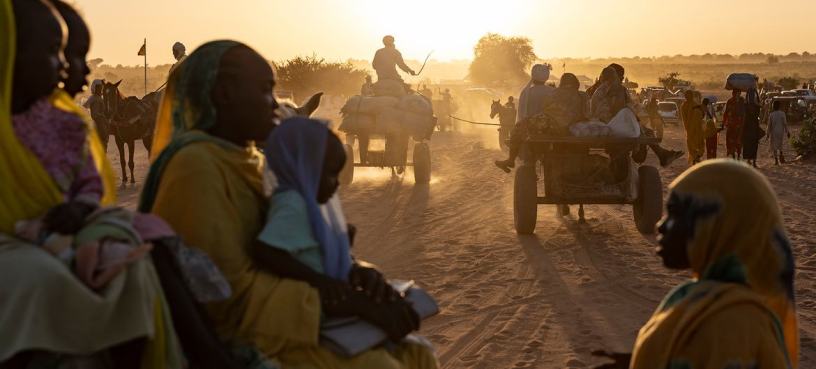
Photo credit: UNHCR/Andrew McConnell
 International Law Blog
The ICJ order dated 5 May 2025 on the APPLICATION OF THE CONVENTION ON THE PREVENTION AND PUNISHMENT OF THE CRIME OF GENOCIDE IN SUDAN (SUDAN v. UNITED ARAB EMIRATES) is quite disappointing. People are forced to wonder and ponder as to the very meaning of international law and the likelihood of getting justice in the existing framework of international law.
The ICJ, (1) By fourteen votes to two, Rejected the Request for the indication of provisional measures submitted by the Republic of the Sudan on 5 March 2025; IN FAVOUR were: President IWASAWA; Vice-President SEBUTINDE; Judges TOMKA, ABRAHAM, XUE, BHANDARI, NOLTE, CHARLESWORTH, BRANT, GÓMEZ ROBLEDO, CLEVELAND, AURESCU, TLADI; Judge ad hoc COUVREUR;
AGAINST were: Judge YUSUF; Judge ad hoc SIMMA;
Then the ICJ, (2) By nine votes to seven, Ordered that the case be removed from the General List. IN FAVOUR were: President IWASAWA; Vice-President SEBUTINDE; Judges TOMKA, ABRAHAM, XUE, NOLTE, BRANT, AURESCU; Judge ad hoc COUVREUR;
AGAINST were: Judges YUSUF, BHANDARI, CHARLESWORTH, GÓMEZ ROBLEDO, CLEVELAND, TLADI; Judge ad hoc SIMMA.
So, the question is whether rule of law is only a dream, and is justice under international law a mirage?
Judge Abdulqawi Ahmed Yusuf who voted against the majority judgment termed this decision an erroneous one as it ignores significant issues and denies parties right to be heard. In paragraph 1, Justice Yusuf held, “…It is a deeply flawed decision. It …gives short shrift to a dispute between the Parties on the jurisdiction of the Court on such consequential legal issues as reservations to the Genocide Convention, and denies them an opportunity to be heard on their dispute. It … conflates “prima facie jurisdiction” with jurisdiction on the merits. It …flies in the face of provisions of the Statute and of the Rules of Court. It … ignores the Rules of Court on the removal of cases from the General List and discontinuance of proceedings and defies the past practice of the Court on these matters…”.
JUDGES BHANDARI, CHARLESWORTH, GÓMEZ ROBLEDO, CLEVELAND, TLADI AND JUDGE AD HOC SIMMA in their JOINT PARTLY DISSENTING OPINION in paragraph 26 noted that there has been a growing recognition of the importance of State responsibility for genocide, not merely individual responsibility. They pointed out that the ICJ’s only substantive jurisprudence concerning State responsibility under the Genocide Convention has come since the DRC v. Rwanda Judgment. In paragraph 27, they opined that “in the interest of the sound administration of justice”, Sudan’s Application should not have been removed from the General List. They added that Sudan should be allowed to contest the scope and validity of the UAE’s reservation to Article IX of the Genocide Convention. This, according to them, reflects a fundamental aspect of a State’s “right to be heard” fully.
Judge Juan Manuel GÓMEZ ROBLEDO in a Dissenting Opinion noted in paragraph 15 that the ICJ’s role as guardian of the Genocide Convention is more crucial than ever. This is because of the fact that there is a rise in number of cases brought before the Court alleging violations of the Convention. Judge ROBLEDO stressed that by removing the Sudan v. UAE case from its List at the stage of provisional measures, the Court failed in its fundamental responsibilities. Interpretation of the Genocide Convention and the law of reservations are important issues to be analysed by the ICJ.
Ad Hoc Judge Bruno SIMMA in his Declaration’s paragraph 11 opined that the ICJ missed a golden opportunity to give the Genocide Convention the “judicial attention it so rightfully, and urgently, deserves”. He wrote, “It would not have been “a bridge too far” to do so”. He was optimistic that the ICJ would revisit these critical issues in future. In paragraph, 12. Ad Hoc Judge Bruno SIMMA held, “…since today’s decision by the Court is not a judgment reached after sufficient hearing of the parties and deliberation in the fullest sense of the term, I have not given up hope that the Court will revisit the issue of limits to reservations excluding the application of Article IX of the Genocide Convention in order to enable the full realization of the Convention’s “purely humanitarian and civilizing purpose”.
Even the majority judgment in paragraph 36 stated that while ICJ manifestly lacked jurisdiction and thereby the Court was precluded by its Statute from taking any position on the merits of the claims made by Sudan. It added that there is a fundamental distinction between the “question of acceptance by States of the Court’s jurisdiction and the conformity of their acts with international law”. Regardless of whether or not States have accepted the jurisdiction of the ICJ pursuant to Article IX of the Genocide Convention, they are required to comply with their obligations under that instrument. Thus, they remain responsible for acts attributable to them which are contrary to their international obligations.
Thus, there is light at the end of the tunnel. Sudan can approach the International Criminal Court to look into the issue of genocide.
Like Ad Hoc Judge Bruno Simma, one can only hope that sooner or later the ICJ would again look into various issues concerning the Genocide Convention, including jurisdiction of the ICJ pursuant to Article IX of the Genocide Convention.
LikeLike