
by Sofia Atsopardi, doctoral candidate at Middlesex University London, currently completing her thesis on the ICJ Climate Change Advisory Opinion
On 7 January 2026 the White House announced a Memorandum signed by President Trump, according to which the United States are to cease their participation and funding to a list of 66 “International Organisations, Conventions and Treaties.” This post takes a look at the Memorandum, starting with a brief overview of its context and significance, and having a focus on climate change. More specifically, it examines the withdrawal from the United Nations Framework Convention on Climate Change (UNFCCC) and other climate and environmental bodies, and considers its effects. It then turns to the International Court of Justice (ICJ) Advisory Opinion on climate change and its findings regarding the customary obligations of States, that exist independently of the climate change treaty obligations. It concludes with a realisation that ramifications of the en masse withdrawal are real and significant, while international law obligations remain for the US.
- Environmental and climate policies from the first to the second Trump administration
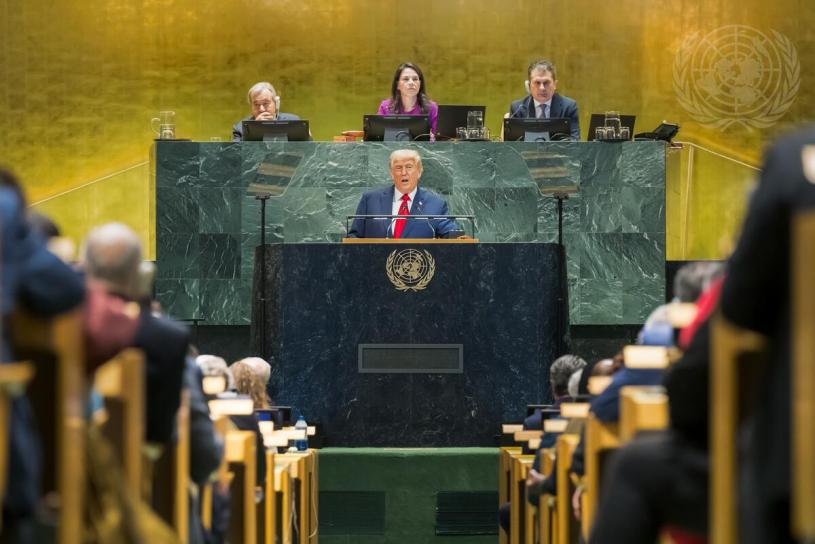
The Trump administration has consistently adopted rather isolating and backward-looking positions, by opting to withdraw from international fora, retracting climate and environmental policies and supporting fossil fuel development domestically. The President himself has been vocal about these issues –for example, at his September 2025 UN address, he referred to global warming as a “hoax” and hailed his presidential actions that promote fossil fuels. During his first term, he rescinded multiple actions taken by the previous government to address climate change through domestic measures and he withdrew the US from the Paris Agreement (1/6/2017).
As soon as he was sworn in office for his second term, Trump issued Executive Order 14162 (20/1/2025), which directed the withdrawal of the US from the Paris Agreement (section 3(a)). This was followed by Executive Order 14199 (4/2/2025) which directed the Secretary of State, in collaboration with the US Ambassador to the United Nations, to conduct a review of international organisations, conventions and treaties of which the US is a member or provides support or funding. Six months (180 days) were allocated to this task and the Secretary of State was required to submit the report together with recommendations on whether the US should withdraw from any of them.
- Content and significance of the Presidential Memorandum in the context of International Law
Having considered the outcomes of the Secretary’s review following Executive Order 14199, President Trump determined that the participation, funding or support of certain international entities –66 in total– goes against US interests; they were announced in his Presidential Memorandum issued on 7 January 2026. The Memorandum does not bring about the withdrawal in itself; US executive departments and agencies are to effectuate it, following the appropriate procedures and timelines for each entity. In reality, the US administration had already started stepping back, since the beginning of their term; for example, they did not submit a greenhouse gas emissions report and did not participate in the CoP30 climate summit in Brazil in November 2025.
There are two categories of international entities listed in the Memorandum: (a) Non-UN Organisations, with 35 entries and (b) UN Organisations, with 31 entries.
The first category includes among others, the Inter-Governmental Panel on Climate Change (IPCC), the International Union for the Conservation of Nature (IUCN) and the Intergovernmental Science-Policy Platform on Biodiversity and Ecosystem Services (IPBES). Regarding specifically the IPCC, it is the international scientific and policy body that produces reports and provides recommendations to policymakers, by assessing and synthesising the most up-to-date findings of climate science. It is recognised as the most authoritative science basis on the matter.[1]
The second category of organisations mentioned in the Memorandum includes 31 committees, organs and offices of the UN, that are not independent organisations. The US does not have a separate membership in all but one of the entities under this category. Therefore it has been noted that the US is not legally withdrawing as such, but rather stepping back from an active presence and engagement in them. In effect this means that they will not seek election or leadership, will not participate in proceedings and will cease the funding that they allocate specifically to them. This is reflected in the text of the Memorandum which states that “For United Nations entities, withdrawal means ceasing participation in or funding to those entities to the extent permitted by law” (Section 1. (c), emphasis added). The US remains a member of the United Nations, and this entails legal obligations under the UN Charter, to contribute to UN budgets. It seems that this is acknowledged in the Memorandum, however whether they will keep up with their mandatory dues, is another matter entirely.
Among the entities included in the second category of Trump’s list, is the UN Framework Convention on Climate Change (UNFCCC), which is the only treaty of the list and the only entity where the US has an independent membership. It is examined more closely in the following section.
- The UNFCCC without the US
The UNFCCC was adopted in 1992 and entered into force in 1994. It is a universally ratified treaty, with 198 members that include all of the UN Member States, the European Union, and some States that do not have full UN membership. The US was the first industrialised state to sign and ratify the treaty. When the withdrawal comes into effect, the US will also become the first country to leave it.
The UNFCCC is one of the pillars of the international climate change law infrastructure. It embodies the understanding of State Parties that climate change is “a common concern of humankind,” a phenomenon that is exacerbated by human activities and that negatively affects some regions more than others. Its objective, stated in article 2 UNFCCC, is for States to stabilise the concentration of greenhouse gas emissions in the atmosphere, in order to prevent dangerous interference with the climate system. The withdrawal process is covered in article 25 UNFCCC and is not immediate –it will come into effect a year after it has been communicated to the Depositary, that is the UN Secretary General (19 UNFCCC). This incurs the withdrawal from additional Protocols to which a State might be a Party. In the case of the US, this is of lesser importance, because out of the two instruments to which this could apply, the US never ratified the Kyoto Protocol and Trump has already announced the intention to withdraw from the Paris Agreement.
In practical terms, having pulled out of the UNFCCC, the US will no longer be able to participate in the Conference of the Parties (CoP), except as an observer (article 7, paragraph 6 UNFCCC). Under the Trump administration the US has not participated in CoP meetings even while being a State Party to the Convention. It has been said that this lack of engagement might be for the better, because it was expected that a US delegation would only complicate negotiations. However, having withdrawn from the UNFCCC will make things difficult for a future US administration that would wish to rejoin it. Due to the way they were each ratified and ensuing domestic law complexities regarding the necessity of Senate approval, returning to the UNFCCC will not be as straightforward as returning to the Paris Agreement.[2] In any case, even without being a member of the climate treaties, a future US administration can always commit to the obligations included therein or adopt “aggressive climate policy independently of them.” In this way the State could be considered compliant with its climate change obligations from customary international law. This is covered in the next section.
- The ICJ Advisory Opinion on Climate Change
In July 2025 the ICJ delivered its much awaited Advisory Opinion on the Obligations of States in Respect of Climate Change. The Advisory Opinion was a seminal moment in international climate justice, as it clarified many contested concepts, and pronounced firmly on the binding nature of climate change obligations of States. The Court systematically examined and specified the obligations entailed in the climate change treaties (UNFCCC, Kyoto Protocol and Paris Agreement; paras 174-267), before delving into the obligations arising from customary international law which are particularly relevant here.
The Court found that the climate change obligations arising from customary law are the duty to prevent environmental harm and the duty of co-operation to protect the environment (paras 271-315). The duty to prevent arises from the risk of harm; in the case of climate change the risk is cumulatively caused from the greenhouse gas emitting activities undertaken in the territory of all States (para 277). The Court affirmed that this obligation is one of due diligence, requiring States to use all means available to them to achieve the goal of preventing harm as far as possible (paras 135, 273). The cumulative nature of the risk does not preclude the existence of the duty, but rather means that an obligation for a “coordinated and cooperative response” arises as part of the standard of conduct required (para 277), which further sets the content of the obligation of harm prevention (paras 280-300).
In paragraphs 309 to 314, the Advisory Opinion refers to the relationship between customary and treaty obligations, reiterating its previous jurisprudence that each might play a role in the interpretation of the other (para 312). It was further established that customary obligations are informed by the standards set in the climate treaties (as interpreted by the Court in the Advisory Opinion), as well as by the practice of States when implementing them (para 313). The Court clarified that the good faith compliance with the treaty obligations might suggest that a State also satisfies its customary obligations. This however does not mean that sole compliance with the treaty obligations, is satisfactory for the customary obligations too (para 314). The Court went as far as to specifically refer to any State that is not a member to the climate change treaties, and clarified that that State’s customary obligations match at least to some extent the obligations of Member States, as well as their practice in conformity with those obligations (para 315). Therefore, if such a State co-operates with “the community of States parties” in a manner equivalent to theirs in conformity to the climate treaties, then this could imply that they discharge their customary obligations through this conduct (this would be the hypothetical case of a future US administration, mentioned in the previous section). On the flipside, the Court concluded that a State which does not cooperate as described above, would be required to “demonstrate[e] that its policies and practices are in conformity with its customary obligations.”
The withdrawal from the UNFCCC and the Paris Agreement, mean that the US will no longer be part of climate negotiations and concerted efforts, provide funding or co-operate in ways that it had done until the beginning of the Trump administration, but a robust set of obligations in respect of climate change remains. In the words of the ICJ: “While the treaties and customary international law inform each other, they establish independent obligations that do not necessarily overlap” (para 315, emphasis added). The Court is clear that obligations enshrined in the climate change treaties, match customary obligations, which might actually extend beyond the former.
- Concluding Remarks – what could possibly lie ahead?
The absence of the United States from climate negotiations and from the global efforts to address the problems caused by climate change is significant. The strategised distancing from these international processes, coupled with the unhindered support for fossil fuels development, demonstrate that the US is moving towards the opposite direction from what is scientifically required to address climate issues. Time will tell if they might progressively become more isolated or if other States will follow suit with similar tactics. Regardless of Trump’s wish to lead a country into going it alone –even one as big and mighty as the United States– climate change obligations exist beyond the climate treaties, for every country including the US. Efforts to reduce harm to the climate system and to control the temperature increase will continue beyond the US’ departure. Such a blunt expression against international entities is indeed a dark page in international law, but what comes next will also be shaped by the rest of States and international actors.
Photo credit: UN Photo/ Mark Garten
[1] ICJ Climate Change Advisory Opinion, paras 60-61, 74-75.
[2] The Biden administration did this for example, in 20/1/2021; https://2021-2025.state.gov/the-united-states-officially-rejoins-the-paris-agreement/.
 International Law Blog
Current era is described by the some of the commentators as an era of deglobalisation. National interests versus global interests is a constant refrain of international relations. This debate has a direct bearing on international law as well. Existing international order is indeed in a state of flux. There appears to be an apparent tension between nationalism and internationalism. Cognitive maps of certain national leaders seem to suggest that aims, objectives, policies and programmes of particular international organisations, institutions, policies, respective national interests are at variance with their own national interests. National sovereignty is the foundation of the world order. Therefore, consent of a nation to join or continue to be part of the treaty, institution etc. is indispensable. The US Presidential MEMORANDUM FOR FOR THE HEADS OF EXECUTIVE DEPARTMENTS AND AGENCIES dated 7 January 2026 is entitled, “Withdrawing the United States from International Organizations, Conventions, and Treaties that Are Contrary to the Interests of the United States”. Source: <https://www.whitehouse.gov/presidential-actions/2026/01/withdrawing-the-united-states-from-international-organizations-conventions-and-treaties-that-are-contrary-to-the-interests-of-the-united-states/>
Traditional observers of world affairs are baffled by the policies of the US under the administration of President Donald J. Trump. One must, however, remember that the Make America Great Again (MAGA) movement in the US has a particular world view and the place of the US in the world. After securing the popular mandate, its representatives and leaders are naturally acting upon the promises made by them to the electorate. Promises made and promises kept! Democratic politics runs on the basis of popularity and majority. Unanimity and consensus are not the requirements in a robust, resilient democracy. In other words, those who disagree with the interpretations of the US national interests as propounded by the present administration, need to wait for the tide of public opinion to change and get it translated into the concrete electoral outcome. Thus, majority may become minority and vice versa. Meanwhile, the world will continue to operate in the given circumstances.
LikeLike