
By Konstantinos D. Magliveras, Professor of Public International Law at the University of the Aegean, coeditor of A Comparison of the European, Inter-American, African and Arab Human Rights Courts: Institutional Aspects (T.M.C. Asser Press / Springer 2025)
- Introduction
Recently, the Financial Times carried an article, which quoted Donald Tusk, the Prime Minister of Poland, as saying that the most important question presently facing Europe was ‘if the United States is ready to be as loyal as it is described in our [NATO] treaties’.[1] Also warning that Russia could attack a NATO member in a matter of months, Tusk’s comments strongly suggest that he was questioning the direction at which the Western world appears to be heading in the area of collective security: ‘I want to believe that [Article 5 North Atlantic Treaty] is still valid … I don’t want to be pessimistic … but what we need today is also practical context’.[2] What he meant by ‘practical context’ is not very clear. However, he did mention the violation of Polish airspace by ‘Russian drones’ in September 2025 and castigated that ‘some Nato allies were reluctant to see it as an attack … it was much easier to pretend that nothing happened’.[3] Moreover, as his comments were made in Cyprus during the April 2026 European Council (informal) meeting, he was most probably also referring to the mutual defence clause in the Treaty on European Union (TEU), Article 42(7).
This note discusses some pertinent aspects of these two provisions, which, according to the TEU, are interrelated, while for many countries in the Western world they constitute the fundamentals of their collective security.
- Article 5 North Atlantic Treaty
Article 5 reads: ‘The Parties agree that an armed attack against one or more of them in Europe or North America shall be considered an attack against them all and consequently they agree that, if such an armed attack occurs, each of them, in exercise of the right of individual or collective self-defence recognised by Article 51 of the Charter of the United Nations, will assist the Party or Parties so attacked by taking forthwith, individually and in concert with the other Parties, such action as it deems necessary, including the use of armed force, to restore and maintain the security of the North Atlantic area’.
Arguably, Article 5 does not expressly regulate the possibility that an armed attack originates from one member and is directed against another member. This is not a theoretical proposition.[4] It is not a secret that in the closing years of the 20th century, Greece and Turkey, two of the oldest NATO members, came very close to armed confrontation. And recent pronouncements by US President Donald John Trump to the effect that the US may annex / gain control over Greenland[5] raise legal questions concerning the use of force against fellow NATO members.
As regards Greenland, the issues involved are succinctly explained as follows. Greenland is an autonomous self-governed part of the Kingdom of Denmark. In accordance with the Act on Greenland Self-Government, ‘the people of Greenland is a people pursuant to international law with the right of self-determination’.[6] Opting for independence is regulated in Article 21 of the Act. In particular, the decision for independence, which must be taken by the people of Greenland, shall be endorsed by a referendum in Greenland, while the ensuing agreement between the Naalakkersuisut (Greenland government) and the Danish Government shall be concluded with the consent of the Folketing (Danish national parliament). But, and it is a very big but, Article 21(4) provides that ‘Independence for Greenland shall imply that Greenland assumes sovereignty over the Greenland territory’. To put otherwise, even if the people themselves wanted to be annexed by the US or be incorporated as the 51st (non- contiguous) US state, it is not possible. Therefore, any US attempt to seize control of Greenland should, by necessary implication, involve the use of force.
It should be noted that another regional collective security system distinguishes between aggression originating from a non-member and from a member. The reference is to the League of Arab States, whose founding agreement was concluded three months before the UN Charter.[7] Article VI of the Pact provides that ‘In case of aggression or threat of aggression by one state against a member-state, the state which has been attacked or threatened with aggression may demand the immediate convocation of the Council. The Council shall by unanimous decision determine the measures necessary to repulse the aggression. If the aggressor is a member-state, his vote shall not be counted in determining unanimity’ (emphasis added).
It is submitted that Article 5 contains nothing more than a promise of providing assistance, not a binding obligation to come to another member’s rescue. And if its application intertwined with Article 51 UN Charter, how NATO members will interpret and apply it in the future is open to question, especially as regards notions such as ‘armed attack’ and ‘self-defence’. However, recent practice shows that members may not have to invoke Article 5 for NATO defences to be activated and to shield members’ territory. And this because members’ consultations under Article 4 could lead to forceful response, if ‘in the opinion of any of them, the territorial integrity, political independence or security of any of the [members] is threatened’. And this is exactly what happened in the aforementioned incident with the drones originating from the Russian Federation in September 2025. Following Poland’s request for Article 4 consultations, members expressed their solidarity with Poland and ‘denounced Russia’s reckless behaviour’ which had violated its airspace. Immediately, this led to military assets from various European states and EU members (the Netherlands, Italy, Germany, etc.) being deployed under the management of the Supreme Allied Commander to address the violation.[8]
One could ask whether NATO would have reacted so swiftly and resolutely if the Russia-Ukraine war was not being waged and this incident was not seen as falling into the scope of the military fighting. To advance this line of thinking, what else could Poland have done if, for whatever reason, no NATO reaction was forthcoming? Naturally, Poland could have complained to the UN Security Council, which it actually did but seemingly after it had managed, with the NATO members’ assistance, to fend off the drones’ attacks. Following Poland’s request, on 12 September 2025 an emergency UNSC meeting took place. While it did not result to any measures being taken, what the EU representative said during the deliberations raises the question whether Poland could have resorted to 42(7) TEU. In particular, the representative said: ‘Russian drones have violated our airspace. It is the latest in a series of violations of EU Member States’ sovereign airspace to have occurred since 2022 … [it] threatens the security of EU citizens’.
- Article 42(7) Treaty on European Union
Article 42(7) was introduced in EU law by the Lisbon Treaty in 2009. It reads: ‘If a Member State is the victim of armed aggression on its territory, the other Member States shall have towards it an obligation of aid and assistance by all the means in their power, in accordance with Article 51 of the United Nations Charter. This shall not prejudice the specific character of the security and defence policy of certain Member States. Commitments and cooperation in this area shall be consistent with commitments under the North Atlantic Treaty Organisation, which, for those States which are members of it, remains the foundation of their collective defence and the forum for its implementation’.[9]
An important matter to clarify is whether the September 2025 incident made Poland ‘the victim of armed aggression on its territory’. Even if the incident was, as the European Parliament has held, one of the many ‘Russia’s intrusions into NATO’s and the EU’s airspace, which represent a blatant violation of Member States’ sovereignty and of international law’,[10] does it meet the conditions laid down in Article 42(7)? Certainly ‘armed aggression’ places a higher barrier than the ‘armed attack’ in Article 5 North Atlantic Treaty. And it does not have the discretionary nature of Article 5: it clearly spells out an obligation to aid and assist the victim. However, if the victim happens to be a NATO member as well, the aid and assistance to be given by those EU states that are also NATO members appears to be whatever action NATO will resolve to undertake, if and when it decides it.
Thus far, Article 42(7) has been invoked only once: on 17 November 2015 by France during the Foreign Affairs Council (meeting as Defence Ministers) following the deadly Paris terrorist attacks four days earlier. Given that unanimously France was promised full aid and support, should one conclude that, from a legal point of view, terrorist attacks leading to deaths constitutes ‘armed aggression’? Because prima facie they do not, unless they were organised, financed and executed directly by a third state. However, from a political point of view, these considerations are probably irrelevant. As of late, the EU appears to have brought the collective security clause out of mothballs because of the uncertainties in the international community. For example, in the speech that European Commission President von der Leyen gave at the Munich Security Conference on 14 February 2026 she said that ‘the time has come to bring Europe’s mutual defence clause to life. Mutual defence is not optional for the EU. It is an obligation … Article 42(7) … It is our collective commitment to stand by each other in case of aggression. Or in simple terms, one for all and all for one. This is Europe’s meaning. But this commitment only carries weight if it is built on trust and capability’.
Moreover, at the aforementioned European Council meeting in April 2026, in view of the overall geopolitical situation, Member States discussed how Article 42(7) can be used in practice. However, any serious discussion cannot avoid delineating the relationship between this provision and the solidarity clause contained in Article 222 of the Treaty on the Functioning of the European Union. Its gist is that the EU and the Member States shall act jointly in a spirit of solidarity if a Member State suffers a terrorist attack. However, this is not going to be solely political action, because Article 222(1) obliges the EU to ‘mobilise all the instruments at its disposal, including the military resources made available by the Member States’ (emphasis added). Presumably, from a legal perspective, it was far more appropriate for France to have invoked Article 222 and not Article 42(7) for the 2015 attacks. At the end of the day, it does not make much difference which Treaty avenue a member will choose to follow. In such cases, the decisions reached by EU Council are not ordinarily subject to scrutiny by the Court of Justice. Member States have seemingly very wide discretion as to how to respond and what measures to adopt in differing situations.
- Conclusions
Lately, we have been reading and listening to how we live in unprecedented times, how we experience the worst crises ever, how everything collapses, in short that all is doom and gloom. It is probably hyperbole. The international community, globally and regionally, has adequate norms, rules and procedures in place and is, on the whole, well equipped to handle all sorts of crises. There are of course conditions, requirements and restrictions attached to these mechanisms, which only work if participating states do not obstruct them and if they do not place national interests over communal interests. On the other hand, it is true that these rules and procedures might be in need of updating, consolidation, coordination, harmonisation, etc. At present and at the level of the North Atlantic Treaty, it does not appear feasible. But EU members should be able to discern that it is high time they revised the Founding Treaties’ provisions on collective security and on addressing threats from whomever they originate, be it friend or be it foe. –
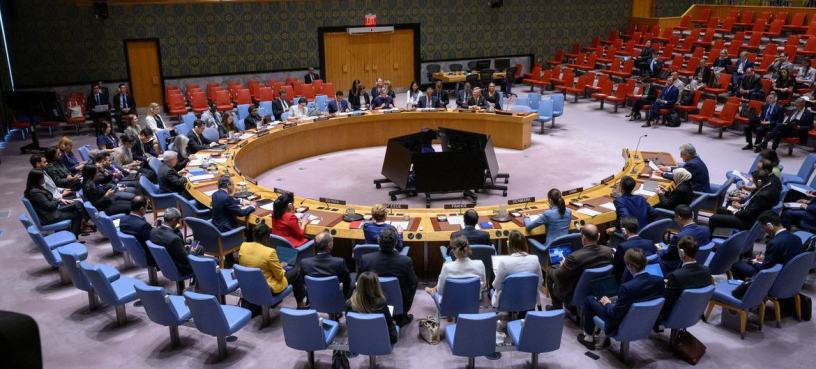
Image credit: UN Photo/Loey Felipe
[1] Henry Foy and Barbara Moens, ‘Tusk queries US loyalty to the defence of Europe’, Financial Times (Europe), 25/26 April 2026, p.3.
[2] Ibid.
[3] Ibid.
[4] Cf. NATO, ‘Collective defence and Article 5’, updated 12 November 2025 < https://www.nato.int/en/what-we-do/introduction-to-nato/collective-defence-and-article-5> which does not mull this question.
[5] See Ian Aikman, ‘Trump says he believes US will ‘get Greenland’’, BBC, 26 January 2025 <https://www.bbc.com/news/articles/crkezj07rzro>.
[6] See Preamble, Act No. 473 of 12 June 2009, English translation <https://english.stm.dk/media/4vgewyoh/gl-selvstyrelov-uk.pdf>.
[7] Pact of the League of Arab States, concluded 22 March 1945, 70 UNTS 241 <https://repository.umy.ac.id/bitstream/handle/123456789/16038/l.%20Lampiran.pdf?sequence=11&isAllowed=y>.
[8] See ‘Statement by NATO Secretary General Mark Rutte on the violation of Polish airspace by Russian drones’, 10 September 2025 <https://www.nato.int/en/news-and-events/events/transcripts/2025/09/10/statement>.
[9] Note that the relationship between the EU Founding Treaties and the North Atlantic Treaty is also regulated under the provisions of Article 351 Treaty on the Functioning of the European Union.
[10] European Parliament, ‘Resolution of 9 October 2025 on a united response to recent Russian violations of the EU Member States’ airspace and critical infrastructure’, P10_TA(2025)0230 <https://www.europarl.europa.eu/doceo/document/TA-10-2025-0230_EN.html>.


Architecture of the contemporary international system seems to be undergoing a metamorphosis. European Union member-states who have traditionally relied upon the United States of America for their security needs, especially since the end of the Second World War, are suddenly finding themselves to be required to take care of their defence requirements. Their overwhelming policy focus on welfare needs to be reversed to where it was until the end of the World War Two i.e. warfare. One may be tempted to ask whether it is an abrupt change or it is culmination of a long drawn process of an incremental change taking place over a number of years. Notwithstanding the predominant popular perception that ‘radical’ shift in foreign and domestic policies of President Donald J. Trump in his second administration (fuelled by MAGA movement supporters) is causing this paradigm shift, the reality is that the geopolitics,economics, demography, market size, scientific and technological innovations etc. are among the myriad factors causing this change over a period of time. Ever since the end of the Cold War in late 1980s and early 1990s, the conventional Euro-Atlantic priorities of the US are being replaced by the Asia-Pacific regional concerns. Moreover, the rapprochement, bonhomie and camaraderie between the US President Donald Trump and the Russian President Vladimir Putin is quite an unforeseen factor in the US-EU and NATO relations. So, Professor Konstantinos D. Magliveras is absolutely right is saying that of late, the EU has brought the collective security clause “out of mothballs” because of the vagaries of the international relations, especially the “shocking” approaches of the US towards EU, Ukraine, Canada, Greenland, apart from the blizzard of tariffs and hurricane of new generation of “pro-US, fair” trade deals. Transactional approach of President Trump has bewildered the so-called allies of the US. It is against this backdrop that the discourse over revival of collective security has gained traction. There is a view that jettisoning welfare and embracing defence (warfare) is the need of the hour. Few EU and NATO members have already promised to enhance their defence budgets. The toughest question, however, is whether all of the EU and NATO leaders (excluding the US) can rise to the occasion and whether they will enjoy widespread public support for adopting such ‘unconventional’ measures. Collective security provisions in various international treaties can be enforced only when all the contracting parties are capable of and willing to discharge their treaty obligations.
LikeLike