
By Mark A. Drumbl and Kirsten J. Fisher
We wanted to talk about an edited collection we just assembled. It is called Reframing Transitional Justice: Innovations, Boundaries, and Refractions. We assembled it because we think the time is right, amid all the current tumultuousness, to give a rethink to where transitional justice and post-conflict reconstruction is going. We are not alone in this. After all, sixteen scholars – who joined us on this path – feel similarly. We are really pleased that International Law Blog is glad to platform the ideas and hopefully prompt a broader discussion.
Why did we wish to undertake this collective journey? Mostly because we hope to challenge the simplicity, predestination, and self-evident nature of contemporary narratives of transitional justice. Reframing Transitional Justice: Innovations, Boundaries, and Refractions does so on three crucial fronts.
The first front is that of innovations. Here, this book questions the ability of transitional justice to deliver tangible successes in an era of rapid and overwhelming technological change and contestation over what constitutes human memory, communicative dialogue, and reliable evidence.
The second front involves boundaries. This book confronts the professed superpower of transitional justice to do more and more, in an endless concatenation of additives. While there is cause for optimism, this book also suggests that transitional justice, as a product of neo-liberal capitalism, remains awkward in how it copes with the existential pressures of environmental, health, and cultural crises.
On its third front, refractions, this book identifies how transitional justice addresses racism, misogyny, and democratic backsliding. How the prism of transitional justice interventions refracts these scourges remains inadequate.
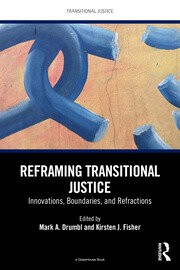
We all hope to propose a future path that remains attuned to the interests of actual victims, to the well-being of the Global South, and to the blossoming of society rather than the entrenchment of the state and ossified international institutions. This book reveals how the sanitised language of transitional justice may become appropriated for political ends including democratic backslides. This book aspires to restore balance, purpose, and equipoise, along with authenticity and actuality in discourse. In short, it aims to reset, to reboot, and—ultimately—to reframe. It hopes for transitional justice to break free from the chains that tether it to its current state, while freeing victim communities from the chains that restrict their self-empowerment. The cover image we selected for this book—a close-up detail from a public mural in Belfast, Northern Ireland—captures this goal. While local in origin, with its own contested and complex history, the content of this image remains wide-ranging in its symbolism.
The following painting by Spanish artist Salvador Dalí inspired us in our reflections.

This painting’s title enigmatically shifted from ‘Visions of Eternity’ to ‘Untitled (Dream of Venus)’. It comprised the left-most portion of a much larger grand mural featured in the 1939 New York World’s Fair. This mural was thereafter disassembled. Its pieces were split apart. Some went to Hiroshima, Japan. Some remain missing. ‘Untitled (Dream of Venus),’ for its part, travelled to the American Midwest. Since the late 1980s it has hung in the Art Institute of Chicago.
The image speaks—to us—about the perched nature of transitional justice while overlooking a parched plane. We hope to invert the imagery through our shared dialogue, that is, to flatten the distance between the level of people and the level of justice while also creating a more welcoming context to more fully populate the plane of transition so that it remains less sparse. Instead of the one arch—suggesting one way of doing things and one entry point—transitional justice could be reconceived in a more diverse, crisscrossing, and crosscutting fashion. While transitional justice retains an eternal quality and a dream-like state, we also hope to make its reality more tangible and immediate. For us, the perched figure exudes anxiousness. We hope instead to think about a calmer and more empathetic transitional justice that, while sensitive, also can guide nimbly rather than prattle nervously. And the beans on the ground—seeds, perhaps dropped by the anxious figure, seeds that fell out of a pocket?—well, they just lie in the shade on the empty, flat, unyielding surface. A strong wind would blow them away and scatter them into nothingness. The seeds do not slip in; nothing will grow from them. We are hopeful for a transitional justice that is more fecund, more fertile, and also more rooted.
Authors hail from eight countries on four continents. They reflect the full gamut of career stages. Indeed, the authors comprise a wonderfully diverse and inclusive group. Case studies considered in this book include Italy, Liberia, the Lusosphere (former Portuguese colonies), Colombia, USA, Libya, Bosnia, Hungary, Syria, and India, among others, along with the metaverse and the world of artificial intelligence.
Reframing Transitional Justice: Innovations, Boundaries, and Refractions presents in three sections that track the book’s title: Innovations, Boundaries, and Refractions. It ends with an epilogue authored by Luke Moffett.
The first section of this book is called ‘Innovations: Artificial Intelligence, Metaverse, and Human Memory.’It considers innovations in the use of new technologies and other creative methods to gather evidence, offer reparative justice or undermine it, communicate the work of transitional justice practices, and produce memory. Transitional justice has enthusiastically pursued the adoption of artificial intelligence, social media platforms, and other mechanisms of crafting memory. While the benefits of such moves have been lauded, this section also recommends caution and reflectiveness. Contributions in this part are: Colleen Murphy. ‘Transitional Justice, Memorialization, and Artificial Intelligence’; Juan Espíndola, ‘Algorithms, Reparations, Repetitions: How Digital Platforms Erode the Aims of Transitional Justice’; Christopher Lamont, ‘Algorithmic Justice: Digital Investigations and Transitional Justice’; Laura Gianna Guntrum, Maike Salzmann, and Christian Reuter, ‘Bridging Justice and Technology: Exploring the Integration of Information and Communication Technologies in Colombia’s Transitional Justice Process’; Daniel Gómez-Uribe, ‘Memory Workshops in Colombia: Co-creative and Inclusive Community Memory Building’.
The second section, entitled ‘Boundaries: The Practice and Challenges of Expanding or Shrinking the Cartography of Transitional Justice,’grapples with the ways in which the boundaries of transitional justice might expand or shrink. Focal points here involve environmental destruction, cultural property, and identification of core crimes. This section features: Rachel Killean, ‘Animals, War, and Multispecies Transitional Justice’; Lucas Lixinski, ‘Transitional Justice, Temporalities, and the Restitution of Cultural Objects’; Mark A. Drumbl ‘Nonchalance and the Fascist Gaze’; and Timothy William Waters, ‘Escaping Genocide’s Gravity’.
The third section — ‘Refractions: Gender, Race, Authoritarianism’—reconsiders how transitional justice interfaces with the iniquities of patriarchy, white supremacy, and movements towards (rather than from) authoritarianism. How does transitional justice refract these iniquities through its procedural prisms and, collaterally, how do these iniquities—and their inequities—refract the substantive goals of transitional justice? This section examines tensions between state and society. Along the way attention is paid to the possibilities, penuries, and pernicious pantomimes of transitional justice vocabularies and best practices—along with how these can be manipulated. Contributions here are: Tiffany Atkins, ‘Abolishing the Family Policing System as Transitional and Racial Justice’; Loyce Mrewa, ‘Liberian Peace Huts as Archetypes of Neotraditional Practices Advancing Gender Justice in Transitional Societies’; Kirsten Campbell, ‘Justice in Transition? The Challenge of Feminist Politics for Transitional Justice’; and C. William Vardy, ‘Beyond Democracy: Alternative Transitions in an Age of Democratic Backsliding’.
The rhythm of this book is a dance—a triple tango of sorts—among needs, wants, and abilities. On the one hand, contributors reveal the breadth of justice needs and the multifaceted nature of what could constitute a transition. There is much more work to do and transitional justice eagerly wants to expand and do it. On the other hand, contributors demonstrate that transitional justice may lack the ability to do more or the capacity to adequately do what it currently aims (and pledges) to do. The danger of over-promising and under-delivering thereby arises. A deficit emerges. In response, sometimes less may be better in meeting wants and needs. In the end, this book strives to articulate a harmony between keeping busy and taking a break. Relatedly, the book also asks readers to consider how we define transitional justice. The definition, boundaries, and abilities of the field are interrelated. Should transitional be limited to human suffering and human rights? Should it be restricted to responding to spectacular harms or expanded to address systemic and entrenched harms that sometimes go unnoticed but have devastating effects on individuals and communities within seemingly peaceful states? What work does the word ‘justice’ do in the term transitional justice?
We invite blog readers to engage with us, or the authors, directly on any of these questions.


This was a really interesting read. I like the idea of looking at transitional justice from different angles instead of treating it as a one-size-fits-all approach.
LikeLike