
By Konstantinos D. Magliveras, Professor of Public International Law at the University of the Aegean, Greece
I. Introduction
The Golan Heights (total area 1,800 square kilometers) lies in Southwest Syria and borders Lebanon, Israel and Jordan. Israel has occupied and administered it since the ‘Six-Day War’ in 1967; more than 20,000 Israeli citizens have settled and live there. The Golan is not sovereign territory of the State of Israel. International law is quite clear: the State that used force to acquire territory of another State may never claim it as its own territory and is prohibited to attempt to change its legal status, to annex it or to create a new state out of it. For this reason, the international community does not recognise the so-called ‘Turkish Republic of Northern Cyprus’ and the unilaterally annexed by the Russian Federation territories of Ukraine (Crimea, oblasts of Donetsk, Kherson, Luhansk, and Zaporizhzhia).
The purpose of this article is to give a historical and legal overview of the Golan’s occupation by Israel, to discuss the US recognition of Israel’s sovereignty over it in 2019, and to offer some thoughts on the August 2026 recognition by Colombia and the ramifications for the always tested international law.
II. Israel’s occupation of the Golan and UN action
In 1981, Security Council (SC) Resolution 497 reaffirmed that, under the UN Charter, under the principles of international law and pursuant to relevant instruments (e.g. SC Resolution 242(1967)), the acquisition of territory by war and force is inadmissible. Therefore, Israel’s decision to impose its laws, jurisdiction and administration on the occupied Golan was null and void and without international legal effect. The SC also demanded Israel rescind forthwith the so-called ‘Golan Heights Law’ (1981) that had changed the Golan’s legal status.
Surprisingly, Resolution 497 was unanimously adopted. Surely the USA would have blocked it! At the time, US President was R. Reagan, a Republican. According to the voting record of Resolution 497, the US representative (a Mr Liechenstein) was adamant that regional peace must be based on two interlocking principles: withdrawal from occupied territories and every State’s right to live in peace within secured borders. He said that the US opposed Israel’s decision to extend permanently its control of occupied Golan; it also did not accept as valid those unilateral acts designed to alter the status of territories occupied by Israel during the 1967 War. Since 1974, the SC has authorised the deployment of a ‘United Nations Disengagement Observer Force’, a peace-keeping operation mandated to maintain the ceasefire between the Israeli and Syrian armed forces in the Golan. Its six-month mandate was last renewed in June 2026 under SC Resolution 2824. Thus, the matter is still in the hands of the SC. Indeed, so far in 2026 it has been discussed some thirteen times.
Six years before Resolution 497, UN General Assembly (GA) Resolution 3414(XXX) had demanded the immediate, unconditional and total withdrawal of Israel from all Arab territories occupied since 1967. Even though the voting record was mixed (84 members in favour, 17 against, 27 abstained, 11 were absent and five did not participate), it was obvious that most UN members condemned Israel’s continued occupation of Arab territories.
The GA has continued denouncing Israel’s occupation as illegal. In December 2025 (80th Ordinary Session), the GA adopted four Resolutions concerning the Arab territories occupied by Israel; two of them related specifically to the Golan.[1] The first, Resolution 80/73 (‘The Syrian Golan’), reiterated for the umpteenth time the GA’s declaration that Israel has failed to comply with SC Resolution 497. The second, Resolution 80/82 (‘The occupied Syrian Golan’), held that all Israel’s legislative and administrative measures and actions purporting to alter the occupied Golan’s character and legal status are null and void, a flagrant violation of international law, and have no legal effect.
III. If Israel is in breach of international law and UN principles, what can be done?
Arguably, the answer is to be found in Article 6 UN Charter. It provides that those members persistently violating the Charter’s principles may be expelled. The principles (Article 2 UN Charter) include the following obligations for members: (a) fulfill in good faith all Charter legally binding duties. Giving full effect and promptly implementing SC resolutions is of course a fundamental duty; (b) not threaten the use of force or indeed use force against any State’s territorial integrity and political independence; and (c) settle all disputes by peaceful means not endangering peace and security. Given that the Charter was concluded in 1945, these principles denote that, following the catastrophic WWII, the use of force was outlawed as acceptable means to resolve inter-State conflicts.
Arguably, the State of Israel has consistently violated these principles. During the last six decades, hundreds of thousands have died as a result; many more have seen their lives ruined. Therefore, the conditions for applying Article 6 against Israel appear to be met. Two observations. First, Israel has the right to justify the violations, e.g. by invoking (self-) defence; it will be up to the SC and the GA to accept or reject the justifications. Theoretically speaking, either organ can ask the International Court of Justice to give its (advisory) opinion on the matter. It is submitted that such a request will be a game changer for the international responsibility of States. Second, Israel is not the only member against which the process of expulsion from the UN should be initiated; the list is long and includes permanent SC members. However, Israel (and all other states consistently and deliberately breaching international law) need not worry, because a provision in Article 6 renders expulsion almost impossible: the requirement that all permanent SC members have concurred before the GA takes a vote on expulsion. Somehow, one cannot envisage permanent members voting in favour of being thrown out or allowing close allies to be thrown out.
With most (if not all) recalcitrant UN members being shielded from expulsion, a measure going back to the Athenian democracy’s ostracism, what prevents the other States from violating the pertinent rules of international law may be ethical considerations (e.g. a continued belief in the post-WWII world order’s cornerstones). Or perhaps the fear that, if they breach them, a more powerful country will unilaterally – and with no prior SC authorization – use force against them or attempt to annihilate them. The April 2026 threat by the US President (referring to Iran) that ‘a whole civilization will die tonight, never to be brought back again’ is a good illustration. At the same time, international crimes are not prosecuted (even though several are investigated), while the ethos of State dignitaries’ impunity prevails.
IV. The USA and Colombia recognise Israel’s sovereignty over the Golan Heights
To return to the occupied Golan Heights’ legal status, in the past the government of Israel had entertained the idea of withdrawing as part of a peace settlement with Syria; however, it was never implemented. According to prime minister Y. Rabin speaking in 1994, a treaty (to be approved in a referendum) would provide for ‘significant withdrawal’ from the Golan in exchange for peace with Syria. But that epoch is long gone. Presently, the general belief seems to be that states may breach international law and face no censure, no consequences. Thus, in 2019 the then US President, D. Trump, a Republican, recognized the Golan as part of Israel’s sovereignty.[2] Evidently as a token of appreciation, Israel named a settlement in occupied Golan ‘Trump Heights’.[3] The Proclamation was discussed during a SC meeting in the afternoon of 27 March 2019. The agenda of the meeting had only one item, the consideration of an update report on the aforementioned Disengagement Observer Force. The US representative (a Mr. Hunter) justified the Proclamation as follows:
“For decades, the residents of the Golan Heights have been subject to the same administration and governed by the same laws as the rest of Israel. The President’s statement on the Golan reflects a recognition of the unique circumstances that led us to deem it appropriate to recognize Israeli sovereignty at this time”.[4]
Two observations. First, an official Proclamation is not a ‘statement’ but a legal instrument of foreign policy having legal consequences. Second, there is a pertinent rule of any legal system, including international law, that unlawful acts cannot be legitimised only because they continued for a long period of time: Quod ab initio non valet, in tractu temporis non convalescit. Therefore, Israel’s illegal occupation and administration of the Golan Heights is and will remain an unlawful act.
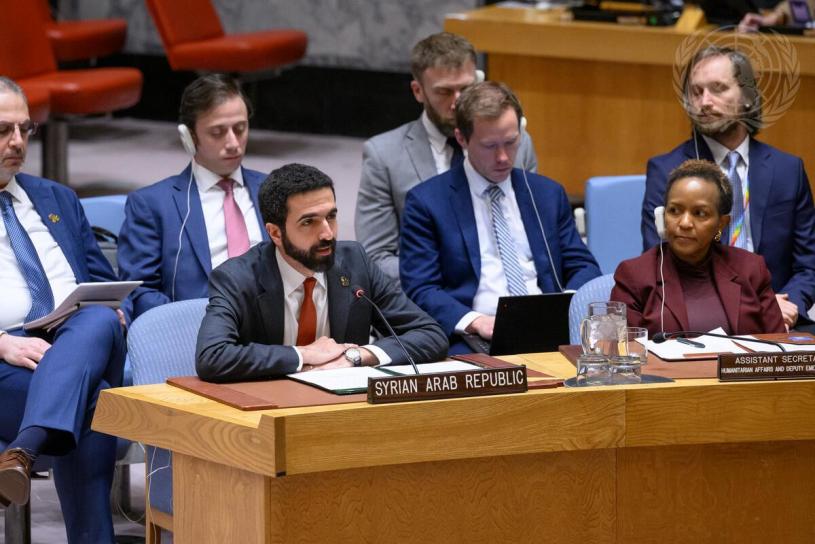
At said meeting, no other SC member spoke on the Proclamation. But the representative of Syria, who was permitted to partake, asked this: considering that the US always talks about accountability for violations of international law, who is going to ask for it to be held accountable for violating the relevant SC Resolutions?[5] Of course, this was a rhetorical question. Even if a member sympathetic to Syria’s positions (say the Russian Federation) had submitted a draft resolution declaring the US to be in breach of the Charter, it would have obviously led to nowhere.
One could argue that the Proclamation counted for little: it was a gesture by a larger ally towards a much smaller ally. And since no other country had recognised the Golan as part of Israel, no need to make a fuss. This was the case until August 2026, when Colombia recognized Israel’s sovereignty over the Golan. The statement justified it on the basis of ‘persistent regional instability in the Middle East and considering the strategic importance of the Golan Heights to the security of Israel’ as well as on ‘the persistent and existential security challenges’ at its borders ‘culminating in the horrific terrorist attacks of 7 October [2023]’. These developments highlighted the gravity and changing nature of the dangers facing Israelis. This led Colombia to recognise that the maintenance of Israel’s control and sovereignty over the Golan constitutes ‘an essential component of its national defence and capacity to protect and safeguard its citizens’. According to the statement, which reversed the previous government’s position,[6] Colombia was committed to a stable and lasting peace in the Middle East.
The Colombian government, which is legally bound by the aforementioned SC Resolutions and should act according to GA Resolutions, failed to ground the statement on international law. It is true that the Constitution of Colombia is rather short on references to the pertinent rules of international law. Thus, Article 226 provides that “[Colombia] shall promote the internationalization of political, economic, social, and ecological relations on the basis of fairness, reciprocity, and the national interest”. Presumably, in this case the national interest of aligning to the present US administration’s support of Israel relegated international law to next of nothing. The Organization of Islamic Cooperation (Syria is a member) condemned the recognition. And so did the Arab League and the European Union. Syria addressed letters of complaint to the SC and to the UN Secretary General.
V. Conclusions
On 27 August 2026, the SC discussed developments in Syria. According to the Press Release (the meeting’s verbatim record has not yet appeared), the question of Israel’s withdrawal from the Golan was deliberated but there was no mention of Colombia’s recognition. The representative of Syria said that the Golan ‘will return to the Syrian people no matter how long it takes’. One could argue that Colombia’s recognition, as the US’ before it, changes very little in the Golan situation. This would be the wrong attitude: every time international law is deliberately and knowingly breached, its authority is compromised and its validity is diminished. And there exactly lies the problem with reckless foreign policy.
[1] The other two are: (a) Resolution 80/81 (‘Israeli settlements in the Occupied Palestinian Territory, including East Jerusalem, and the occupied Syrian Golan’), and (b) Resolution 80/158 (‘Permanent sovereignty of the Palestinian people in the Occupied Palestinian Territory, including East Jerusalem, and of the Arab population in the occupied Syrian Golan over their natural resources’).
[2] Proclamation 9852 – Recognizing the Golan Heights as Part of the State of Israel, 25 March 2019, <https://trumpwhitehouse.archives.gov/presidential-actions/proclamation-recognizing-golan-heights-part-state-israel/>; (2019) 113 American Journal of International Law 613 – 619, https://doi.org/10.1017/ajil.2019.35.
[3] BBC, ‘Golan Heights: Israel unveils ‘Trump Heights’ settlement’, 16 June 2019, https://www.bbc.com/news/world-middle-east-48656431; I. Kershner, ‘A Glitz-Free Place Named for Trump? Welcome to the Golan Heights’, The New York Times,5 September 2026, < https://www.nytimes.com/2026/09/05/world/middleeast/israel-golan-trump-heights.html>.
[4] Security Council, 8495th meeting, 27 March 2019, S/PV.8495, p. 4
<https://documents.un.org/doc/undoc/pro/n19/088/34/pdf/n1908834.pdf>.
[5] Ibid., p. 16.
[6] As late as 31 March 2026, Colombia considered Israel’s annexation as illegal; it voted in favour of UN Human Rights Council Resolution 61/31, ‘Israeli settlements in the Occupied Palestinian Territory, including East Jerusalem, and in the occupied Syrian Golan’, which quoted the ICJ Advisory Opinion on the Legal Consequences of the Construction of a Wall in the Occupied Palestinian Territory (9 July 2004).


International law is a derivative and function of many other influences – good and evil. The Golan Heights issue is an obvious reminder of this multi-faceted nature of international law. Both the sides have equally powerful and persuasive arguments to bolster their respective claims. Members of international community, located within the region and outside it, have their own perceptions, aspirations and priorities. These may or may not always match with the policies of the disputants. In fact, it is a diplomatic tightrope walk to do for most of the governments around the world. Unless and until there is a conclusive judicial determination or there is a massive change of heart and unprecedented reconciliation by the concerned parties themselves, one does not know the satisfactory solution acceptable to all the stakeholders. Justice remains an elusive goal in such peculiar circumstances. That is how the yawning gulf between (international) law and justice remains intact.
LikeLike