
By Federico Jarast, Jefe de Trabajos Prácticos at Buenos Aires University School of Law and Partner at Australis Arbitration, Buenos Aires.
The nerve-wracking semifinal of the 2026 FIFA World Cup between Argentina and England might be open to conflicting appreciations on what happened on the field from two different points of view.
From the sport´s perspective, those memorable 105 minutes of game surfaced two contrasting ways of how decisive matches should be played, two irreconcilable tactical approaches. The prevalence of one method over the other seems to be well proved; the reasons for such outcome, too.
But even more important than the lessons to be extracted from the match itself are those related to the developments taking place over that same field, right after the end of the game. As understandable as England´s bitterness is, considering that it was only minutes away from defeating the defending world champion and making it to a final for the second time in its history, after nothing less than six decades; it is certainly sad to see the British government prompting FIFA to investigate the display of a Malvinas banner, as if the prospect of sanctions against the team and/or the Argentinian Football Association -AFA- could offset the team´s performance. The present piece aims to expose some of the underpinnings of this incident not through the lens of Sports Law, but from an International Law viewpoint; trying to prevent FIFA from meddling in a dispute way beyond the realm of its competence.
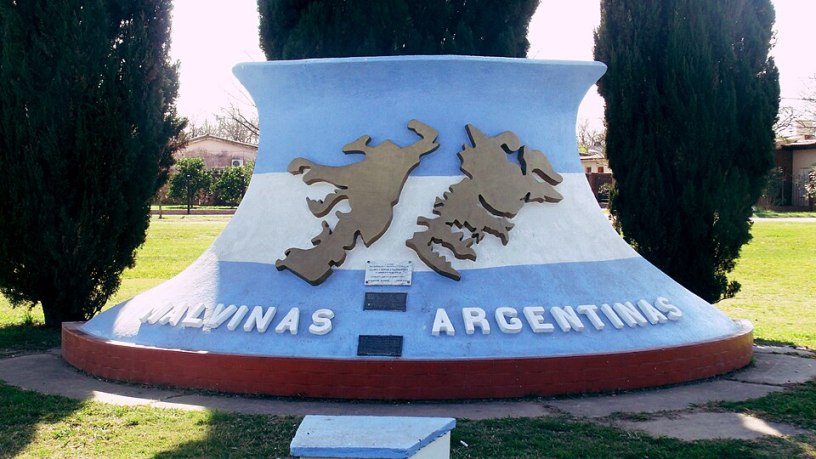
Most people are well acquainted with the facts: immediately after the Argentine victory over England, a banner stating “Las Malvinas son argentinas” –“The Malvinas are Argentine”- was exhibited by some players of the winning team. What many seem to ignore is the latent dispute, and the array of legal arguments that have been developed for decades in relation to it.
To start with, it is worth recalling that, more than a century ago, a dispute was defined as “a disagreement on a point of law or fact, a conflict of legal views or of interests between two persons” (PCIJ, The Mavrommatis Palestine Concessions [1924] PCIJ Reports Series A No 12, 11); to which it was added later on that its existence is “a matter for objective determination” and that “[t]he mere denial of the existence of a dispute does not prove its non-existence” (ICJ, Interpretation of Peace Treaties with Bulgaria, Hungary and Romania [1950] ICJ Reports 65, 74).
For its part, the Charter of the United Nations devotes a whole Chapter to the pacific settlement of disputes (Chapter VI), whose opening article stipulates that “[t]he parties to any dispute, the continuance of which is likely to endanger the maintenance of international peace and security, shall, first of all, seek a solution by negotiation, enquiry, mediation, conciliation, arbitration, judicial settlement, resort to regional agencies or arrangements, or other peaceful means of their own choice” (article 33.1).
In this sense, it is critical to assess whether the situation ensuing the British forcible seizure of the islands in 1833 -that is, almost a century before the first FIFA World Cup was held in Uruguay- actually constitutes a dispute. Far from controversial, this point has been settled by the international community back in the 1960´s, when the General Assembly of the United Nations referred to the “cherished aim of bringing to an end everywhere colonialism in all its forms, one of which covers the case of the Falkland Islands (Malvinas)”; noting in furtherance “the existence of a dispute between the Governments of Argentina and the United Kingdom of Great Britain and Northern Ireland concerning sovereignty over the said islands” (Resolution 2065(XX)). In consonance, the United Nations Secretariat would prepare an Editorial Directive decades later, through which it stated that the name to be applied to the territory in question is “Falkland Islands (Malvinas)”, in English, and “Islas Malvinas (Falkland Islands)”, in Spanish (para 1); adding that “where a reference to the Falkland Islands (Malvinas) may raise or bear upon the question of sovereignty over the Territory, it should be accompanied, as the case requires, […] by a note or footnote reading: ´A dispute exists between the Governments of Argentina and the United Kingdom of Great Britain and Northern Ireland concerning sovereignty over the Falkland Islands (Malvinas)´” (para 4) (UN Document ST/CS/SER.A/42).
Accordingly, there is no questioning that the United Nations itself has acknowledged the existence of a long-standing dispute between Argentina and the United Kingdom; a fact that remains unaltered despite the latter´s recalcitrant denial. Two very distinct features that cannot be overlooked when delving into this dispute are: a) that it is framed in the broader context of decolonization; and b) that it pertains to the sovereignty over the islands.
In connection with the first aspect, by the time Argentina was lifting its second World Cup, it was already stated that “there can […] be no question of even circuitously finding in contemporary international law any retroactive legitimation whatever of colonialism as an institution” (ICJ, Frontier Dispute -Burkina Faso/Republic of Mali- [1986] ICJ Reports 554, Separate Opinion of Judge ad hoc Abi-Saab, para 4). Well into the 21st century, the authority of this assertion can only be amplified.
Things get a bit more technical when it comes to the second prong, though for the sake of simplicity, I will limit myself to addressing a specific point. It has been said that “pre-eminence is to be accorded to legal title over effective possession as a basis of sovereignty” (ICJ, Frontier Dispute -Benin/Niger- [2005] ICJ Reports 90, para 47); and this is the exact core of the Argentine claim. Being “legal title” a term of art in International Law, account should be taken of the fact that it refers both to any evidence which may establish the existence of a right, as well as to the actual source of that right (ICJ, Land and Maritime Delimitation and Sovereignty over Islands -Gabon/Equatorial Guinea- [2025], para 43). Considering that “[t]hrough succession, the successor State acquires the title held by the predecessor State” (ibid., para 182), part of Argentina´s argument is that its sovereignty stems from the Spanish Empire´s sovereignty over the islands in 1816, the year when Argentina gained its independence.
Coming back to the semifinal, it should be noted that for the investigation of the Argentine team and AFA, the FIFA World Cup 2026 Code of Conduct does not seem to apply as the players are clearly excluded from its jurisdiction ratione personae; despite the fact that it devotes Section 3.1.24. to “Flags and Political / Offensive / Commercial Items”. Looking into the FIFA Disciplinary Code (May 2026 Edition) may prove more helpful, as Section 17 refers to the responsibility of the member associations for “the use of gestures, words, objects or any other means to transmit a message that is not appropriate for a sports event, particularly messages that are of a political, ideological, religious or offensive nature” (Subsection 2.e). And it is at this juncture where FIFA regulations cannot ignore International Law: a banner as the one in question is nothing more than the expression of Argentina´s legal title to the islands, to put it in technical terms. The message cannot be labelled as political, ideological, religious or offensive in any manner. No derogatory words were included: no reference to imperialism or decolonization was made, no pejorative language was used to refer to the inhabitants of the islands, no defense of the 1982 war was offered. Such respectful utterance of a strictly legal argument constitutes the most powerful vindication of Argentina´s commitment to resolve the dispute, and to do it peacefully. Therefore, the message is absolutely concordant with a sports event whose professed aim is to bring the world together.
The British craving for sanctions within the FIFA framework is far less concerning than the utmost disregard for International Law expressed at the highest echelons of the government. For example, the Prime Minister´s spokesperson stated that “[t]he World Cup might not be ours, but the Falkland Islands definitely are”. In the same vein, the Foreign Office Minister, Stephen Doughty, affirmed: “[w]e have absolutely no doubt about our sovereignty over the Falkland Islands and the surrounding maritime areas.” It is interesting to notice that, despite the UN´s current inclusion of the Malvinas in the List of Non-Self-Governing Territories (a controversial aspect that exceeds the scope of this post), the British authorities insist that they have sovereignty over the islands, notwithstanding Chapter XI of the UN Charter and the reference to the dispute explicitly included as a footnote to the list.
By 1965, the UN General Assembly had already invited the Governments of Argentina and the United Kingdom “to proceed without delay with the negotiations recommended by the Special Committee on the Situation with regard to the Implementation of the Declaration on the Granting of Independence to Colonial Countries and Peoples” (Resolution 2065(XX), para 1). As recently as 2025, the Special Committee still had to request “the resumption of negotiations […] with the aim of finding a lasting solution to the sovereignty dispute” (Report of the Special Committee on the Situation with regard to the Implementation of the Declaration on the Granting of Independence to Colonial Countries and Peoples for 2025, para 32). In 2026, the British are scandalized by the display of a banner after a football match, while Argentina is expected to tolerate the Foreign Office Minister asserting that “[t]he Falkland Islands are British, they remain British and they will continue to be British”.
The British unwavering denial to negotiate with Argentina not only mocks International Law in general terms, it neglects the decades-long struggle of the United Nations to bring colonialism to an end while it also undermines the message of unity that FIFA has struggled to permeate through the 2026 World Cup.


Things are not as simple as they appear to one. It might be quite intriguing to an ordinary observer to see an international sports event (FIFA football match) between Argentina and the UK being easily turned into a controversial international law-cum-politics and a geo-strategic issue. “Falkland Islands”, in English, and “Islas Malvinas”, in Spanish dispute between Argentina and the UK reminds one of the painful history of colonialism, imperialism across the world, and the colonised people’s rightful struggles for independence, right to self-determination, national sovereignty and territorial integrity. While watching the sports events, the spectators must have a desperately required spirit of sportsmanship so that the successful team (winner) is duly appreciated and congratulated, and the losing team gets an opportunity to play better next time. Likewise, peaceful, just and equitable international system can survive and thrive only if there is a spirit of statesmanship among rulers of all nations – small and big, rich and poor, winners and losers. It makes little sense to perpetuate colonialism and deny freedom. The Charter of the United Nations must be respected in its letter and spirit.
LikeLike