
By Konstantinos D. Magliveras, Professor of Public International Law at the University of the Aegean, Greece
- Introduction
If during armed hostilities between countries, one of them controls for long periods of time the territory of an opponent acting as an occupation force and the occupied country’s population flee it en masse, a legal question that arise is that of the property rights on land and structures. If there has been considerable destruction and new building permissions must be issued, to produce proper titles proving the corresponding rights is imperative. A Financial Times article brought up these matters in relation to the residents in the Gaza Strip,[1] who have been displaced during the armed hostilities between Isreal and Hamas following the latter’s 7 October 2023 attack.[2] In May 2026, the situation was described as follows: c. 85 per cent of buildings and infrastructure have been damaged or destroyed, an estimated 70 million tons of rubble require clearing, and at least one million people needed permanent shelter.[3] Palestinians, who have fled and return to Gaza, will have to prove ownership of the destroyed property they (claim they) owned before displacement. The purpose of this note is to examine certain aspects of property rights in war-torn Gaza and offer some hopefully pertinent suggestions.
- Establishing property rights in the Gaza strip. Lodging claims against Israel for the destruction of property in Gaza
For the following reasons, the situation is of considerable complexity. First, because of the constant Israeli bombardments (arguably illicit due to ferocity and targeting installations, infrastructure, buildings, etc. protected under international humanitarian law), the land registry, and more generally public authority offices, have been destroyed, physical evidence lost and unable to be recovered. Second, private property holdings in Gaza were seldom registered with the land registry, even though it has existed since the Ottoman times. Third, on account of the territory of Palestine being successively ruled by the Ottomans, the Egyptians and the British, many land titles are obscure (to say the least). Finally, as tens of thousands of the local population have been killed mostly by the Israeli Defence Forces (IDF), there are obvious complications in property rights being inherited by the next of kin, who may themselves have been displaced, fled or, worse, died. Since 7 October 2023, the estimated number of deaths reportedly exceeds 74,000; the number of injured persons is more than double this figure.[4]
Since the situation in Gaza qualifies as force majeure (not just hardship[5]), if (physical) land titles cannot be produced or are disputed, other evidence should be accepted to prove property rights: tax returns, electricity bills, water bills, wills and testaments, signed testimonials by locals, in short whatever will substantiate claims. On the other hand, to ensure legal certainty, to avoid gross errors and to comply with the rule of law, a functionable system of justice based on appropriate regulation is required to guarantee that claims are widely advertised, opposing claims are presented and adjudicated by competent judicial organs or independent administrative authorities. For the foreseeable future, this is impossible in Gaza. On the other hand, if ad hoc solutions are applied, they might lead to even more complex situations. However, Palestinians with property rights on land and buildings and documented destruction by the IDF in Gaza, may bring civil actions for compensation against the State of Israel before Israeli courts. The legal basis is the general rule that aliens, who are not domiciled in a third State but allege injury / loss incurred by it, are allowed to bring claims against it before its domestic courts. Whether such lawsuits will be considered admissible and adjudicated is another matter.
- Israel as the occupying force in Gaza, recognition of property rights and the Comprehensive Plan to End the Gaza Conflict
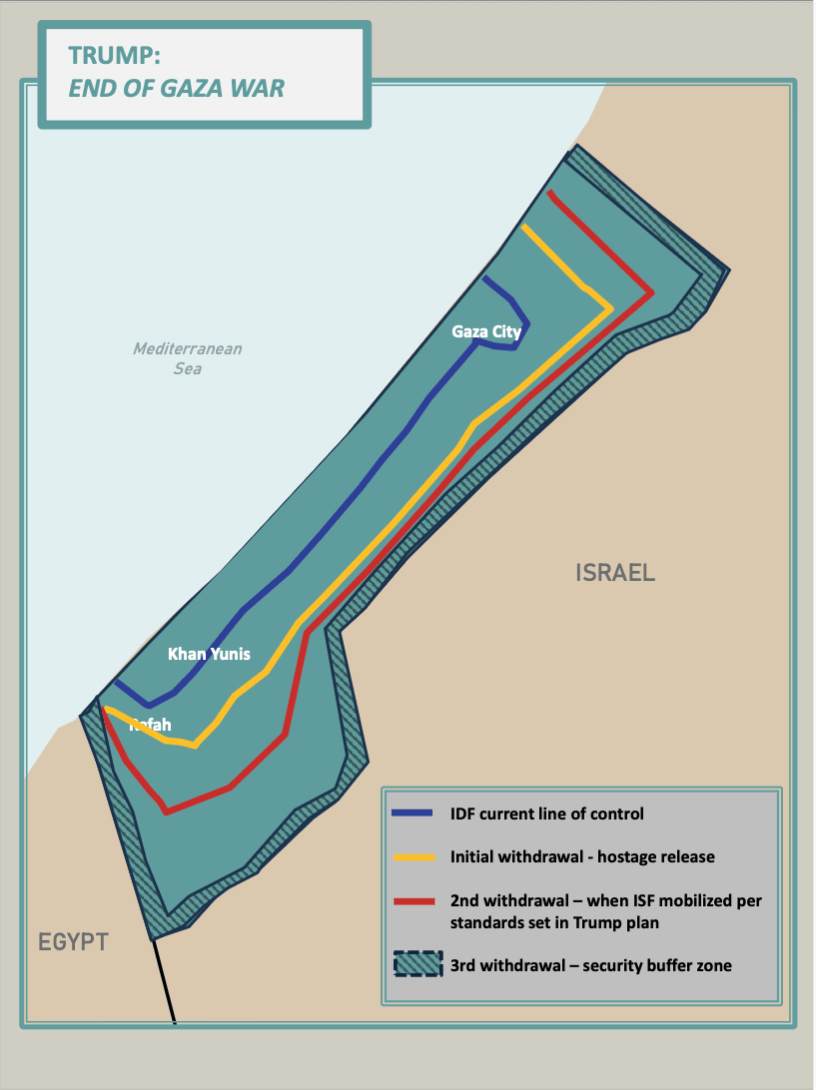
In this state of affairs, there is a paradox: Israel is not required to show that it possesses property rights to implement its plans to alter spatial planning in the Gaza Strip, effectively to redraw the pre-October 2023 map.[6] As the occupying force of presently 60% of Gaza’s territory, Israel maintains full control on all immovable property therein, while having full military control over Gaza’s maritime space, including its 40-kilometer Mediterranean coastline. The manner by which Israel continues to occupy land in Gaza, which at least in theory is part of the State of Palestine, is most probably illegal, especially as Israel has no concrete plan to withdraw. Two observations. First, the current regime in power in Palestine is very quiet negatively affecting the status quo in Gaza. Second, Israel has a right to (self-)defence. It legitimises Israel to hold some land in Gaza (but not 60%), establish buffer zones (without evicting the population) and take other objectively necessary measures. The present situation that IDF has created in Gaza appears to breach the so-called ‘Comprehensive Plan to End the Gaza Conflict’ (‘Comprehensive Plan’). This incorporates the Hamas-Israel ceasefire agreement, announced on 29 September 2025, endorsed in Egypt by several States on 13 October 2025, and annexed to UN Security Council (SC) Resolution 2803 (2025) of 17 November 2025.
Arguably, Resolution 2803(2025) is a Chapter VII instrument as it was principally based on the wording ‘Determining that the situation in the Gaza Strip threatens the regional peace and the security of neighboring states …’, i.e. the required determination under Article 39 of the UN Charter for the SC to takes action to maintain/ restore peace and security. Resolution 2803 is a remarkable instrument, not least because it was approved as the Big Five’s interests had entered into a seldom constellation. Today, it would probably be impossible to even draft such a resolution.
But Resolution 2803(2025) is mostly wishful thinking and includes unrealistic undertakings, e.g. the International Stabilization Force (ISF) in Gaza, which was created with a temporal mandate and whose immediate deployment is envisaged in Point 15 of the Comprehensive Plan. ISF has not yet been established and might never become operative.[7] Such projects require significant level of funding (the UN makes no financial contribution), clear goals and commitments. Presumably, it does help if States have direct interests, there are benefits to be gained and interests to be served. Or if there are unifying factors present (religion, language, history, culture) making aid and assistance an ethical duty. We will return to this point as it is related to the Gaza Strip’s reconstruction.
While not an urgent priority, had ISF been in operation, it could have assisted in implementing workable solutions vis-à-vis lost property titles. Pursuant to Resolution 2803(2025), ISF is instructed to, inter alia, ‘undertake such additional tasks as may be necessary in support of the Comprehensive Plan’. This should be linked with Point 2 thereof, which provides that ‘Gaza will be redeveloped for the benefit of the people of Gaza’. Therefore, redevelopment may not exclude those who, before 7 October 2023, held property rights, notwithstanding that they may be problematic. Reference should also be made to Point 19 thereof. It envisages a ‘…credible pathway to Palestinian self-determination and statehood, … the aspiration of the Palestinian people’. An admittedly broad reading of Point 19 allows the conclusion that the status of property in Gaza cannot never be altered, irrespective of Gaza’s de facto occupation by the IDF. To put it into context, for a population to advance towards self-determination and claim statehood, its territory (land, air and sea) must belong to and be controlled by the population itself, not by a third State, and never by an occupying force whose presence was never permitted by the SC.
Considering that the State of Israel is the occupying force in Gaza (and other parts of the Palestinian territory for that matter), international law places obligations and duties upon it. As is well known, the UN General Assembly (GA) asked the International Court of Justice (ICJ) to advise as to which these obligations are. It its Advisory Opinion of 9 July 2024 [Legal Consequences arising from the Policies and Practices of Israel in the Occupied Palestinian Territory, including East Jerusalem], the ICJ did so. And then the GA asked it for a supplementary opinion, delivered on 22 October 2025 [Obligations of Israel in relation to the Presence and Activities of the United Nations, Other International Organizations and Third States in and in relation to the Occupied Palestinian Territory]. To implement the findings of the latter Opinion, on 12 December 2025, the GA adopted Resolution 80/116 by 139 votes in favour, 12 votes against (Argentina, Bolivia, Fiji, Hungary, Israel, Micronesia, Nauru, Palau, Papua New Guinea, Paraguay, Tonga, USA), and 19 abstentions.
Of particular interest is para. 5 of the operating part of Resolution 80/116. It demands that Israel comply without delay with all its legal obligations under international law for the reasons given by the ICJ, including to immediately comply with its obligations as an occupying power and a UN member and administer the territory for the benefit of the local population and also respect, protect and fulfil the human rights of the population of the ‘Occupied Palestinian Territory’ (emphasis added). These two duties must be read together because the right to property is a human right that the population of Gaza (part of the ‘Occupied Palestinian Territory’) enjoys pursuant to Article 31 of the Arab Charter on Human Rights 2004. Palestine is a contracting party to it. It reads: ‘Everyone has a guaranteed right to own private property, and shall not under any circumstances be arbitrarily or unlawfully divested of all or any part of his property’.
- Conclusions
It follows that any new spatial planning of the Gaza Strip may not ignore the property rights of the now mostly displaced population. Currently, the apparent lack of public authorities in Gaza blocks any procedure to accept/recognise/verify land rights. As argued: ‘Th[e] legal limbo [in Gaza] impedes active management of land and water for economic, agricultural, public services, and environmental purposes’.[8] But Israel, as the occupying power, has a duty to respect existing property rights, to assist in re-establishing credible community authorities to serve the needs of the population and ensure that their rights and freedoms are fully observed as well as exercised without hindrances, and it is prohibited from starting confiscating land in Gaza, as it has consistently done in the West Bank (Jordan Valley). Israel is not allowed to proceed unilaterally with a new spatial planning of the Gaza Strip as if there were no existing land titles and property rights. Occupation of territory in another country does not abolish property law.[9][10]
According to the Report submitted to the SC in May 2026 by the so-called ‘Board of Peace’ (its establishment as Gaza’s transitional administration was ‘welcomed’ in Resolution 2803(2025)), ‘an ambitious, phased reconstruction plan that would see permanent housing and key infrastructure rebuilt for the people of Gaza’ is prepared, while the total cost of reconstruction was projected to exceed USD 30 billion.[11] To return to the point made above, the plan for a new Gaza lacks funding and is arguably not supported by a committed group of States, while IDF reportedly continues to seize territory.[12]
Image credit: Wikimedia Commons
[1] H. K. Tapper & H. Saleh, ‘Gazans race to recover property rights from rubble’, FT (European edition), 14 September 2026, p. 3.
[2] Namely, the armed incursions into the so-called ‘Gaza envelope of southern Israel’ resulting in c. 1,300 Israelis killed and c. 250 Israelis abducted, many of whom died in captivity.
[3] See ‘Implementation of UN Security Council Resolution 2803 (2025): Report of the Board of Peace through the Office of the High Representative for Gaza’, UN Doc. S/2026/418, 15 May 2026, para. 26, at: https://digitallibrary.un.org/record/4114041?v=pdf.
[4] United Nationals Office for the Coordination of Humanitarian Affairs, ‘Reported impact snapshot | Gaza Strip (30 September 2026)’, at: https://www.ochaopt.org/content/reported-impact-snapshot-gaza-strip-30-september-2026.
[5] Generally, see E. M. AlQodsi et al, ‘Suspension of the statute of limitations for civil claims: A comparative study of arab legislations’ (2024) 10 Social Sciences & Humanities Open, https://doi.org/10.1016/j.ssaho.2024.101129.
[6] See e.g., BBC, ‘Israel building new land barriers in Gaza and displacing families’, 30 July 2026, at: https://www.bbc.com/news/articles/cpvwjmme3p0o.
[7] DW, ‘What’s holding up the Gaza stabilization mission?’, 22 July 2026, at: https://www.dw.com/en/whats-holding-up-the-gaza-stabilization-mission/a-78066920.
[8] See S. Culbertson et al, ‘Spatial Vision for Palestine – A Long-Term Plan That Can Begin Now’, Rand, 8 April 2025, at: https://www.rand.org/pubs/research_reports/RRA3444-1.html.
[9] UN High Commissioner for Human Rights, ‘State of Palestine: Israeli Settlements in the Occupied
Palestinian Territory, Including East Jerusalem, and in the Occupied Syrian Golan’, March 2024, at: https://www.un.org/unispal/wp-content/uploads/2024/02/Palestine-March2024.pdf.
[10] For an overview of property law in Palestine, see https://lawgratis.com/blog-detail/property-law-in-palestine.
[11] Supra note 3, para. 27.
[12] H. Saleh & J. Shotter, ‘Israel conducts ‘scorched-earth’ campaign in Gaza one year into US-brokered truce’, FT (European edition), 10 October 2026, p. 3

