
Percy Yixuanchen Yu is the Inaugural Visiting Fellow at the School of International Studies, Nanjing University; a Visiting Scholar at the Huazhi Institute for Global Governance; and a Non-resident Fellow at the Institute of Campaign Finance.
Non-recognition must govern the everyday administration of a ceasefire, as well as its territorial clauses. Protecting civilians requires contact with those who control territory; it does not require accepting conquest as a source of rights.
A ceasefire can save lives before it resolves a war. The limited truce around Oleshky, intended to permit aid deliveries and evacuations, illustrates why immediate humanitarian relief cannot await a comprehensive settlement. But a wider agreement in Ukraine would face a harder question: how can arrangements with an occupying power reduce suffering without consolidating its claim to sovereignty?
The answer begins with a distinction between a line that regulates military conduct and a boundary that determines territorial rights. It cannot end there. An agreement might disclaim recognition of annexation while its maps, administrative procedures and treatment of property gradually reproduce the annexing state’s claims. The legal test must therefore reach beyond what negotiators call the settlement to what its institutions actually do.
This distinction is already part of the debate. In his discussion of a possible settlement, Marc Weller examined how territorial questions might be deferred without recognizing acquisition by force. The next task is to make that separation operational: permit cooperation needed for civilian life, preserve rights that military control cannot extinguish, and give each external undertaking an identifiable bearer of responsibility.
A Military Line Cannot Settle Legal Title
Russia and Ukraine did not enter this war without an agreed territorial baseline. Their 2003 land-border treaty defined a boundary through its description and map. It is not a comprehensive answer to every maritime issue or every claim arising from the war. Its relevance is more precise: a historical narrative cannot simply displace a boundary that the states themselves agreed.
Boundary law is designed to resist that instability. In Territorial Dispute (Libyan Arab Jamahiriya/Chad), the International Court of Justice explained that an established boundary has a legal life independent of the treaty that created it. Article 62 of the Vienna Convention on the Law of Treaties also excludes boundary treaties from termination on the ground of a fundamental change of circumstances. These rules do not resolve battlefield control. They prevent changing circumstances from becoming an unrestricted license to reopen territorial title.
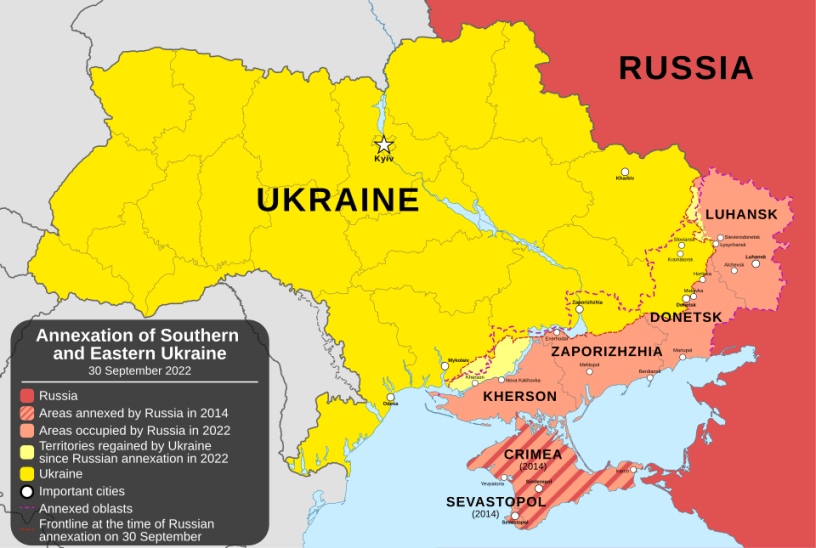
The relevant baseline is therefore legal, not a judgment about which national history is more emotionally compelling. In Resolution ES-11/4, the UN General Assembly rejected the purported referendums and attempted annexation of four Ukrainian regions. Negotiators can address the reality of Russian control without treating that control as an entitlement Ukraine must purchase back.
Nor is non-recognition merely a concession that outside governments can exchange for a more convenient settlement. Articles 40 and 41 of the International Law Commission’s Articles on State Responsibility set out consequences for serious breaches of obligations arising under peremptory norms, including duties not to recognize the resulting situation as lawful or assist in maintaining it. These articles are not themselves a treaty, and their application requires attention to the underlying obligation. They nevertheless supply an essential framework for assessing arrangements that would legitimize territorial acquisition by unlawful force.
A ceasefire text should accordingly identify a military line by function and date, preserve Ukraine’s territorial rights, and state that implementation does not settle sovereignty. Maps and annexes must carry the same distinction. An operational boundary for patrols, deliveries or separation of forces should not silently become a frontier in another part of the agreement.
Civilian Life Cannot Be Suspended Pending Sovereignty
Non-recognition cannot mean treating the population under occupation as legally invisible. People need medical care, family documentation and usable records of their lives. If every interaction with a de facto authority were treated as recognition, civilians would bear the cost of defending a principle intended partly to protect them.
The ICJ addressed this problem in its Namibia advisory opinion. While requiring non-recognition of South Africa’s unlawful presence, the Court distinguished acts such as the registration of births, deaths and marriages, whose disregard would harm inhabitants. That reasoning does not authorize every transaction with an occupying administration. It shows why legal rejection of an unlawful situation must remain compatible with protecting the people living within it.
For Ukraine, this suggests a practical distinction between acknowledging an individual fact and accepting an asserted sovereign power. A mechanism might allow a child to establish identity using a locally issued birth record without validating the issuer’s claim to govern the territory. The same justification would not automatically extend to a confiscation order purporting to transfer an owner’s property permanently under annexation legislation. The legal effect sought, the rights affected and the available safeguards all matter.
Negotiators should build that distinction into the agreement’s working procedures. Humanitarian contacts can identify counterparts by operational responsibilities without assigning sovereign status. Arrangements for civil records can specify that acceptance protects individuals and does not validate annexation. Property claims can be recorded and preserved while disputed ownership remains unresolved. These provisions would need competent institutions and accessible procedures; a broad reservation of rights cannot cure otherwise unlawful conduct.
The law of occupation supplies a further limit. Article 47 of the Fourth Geneva Convention prevents protected persons from losing Convention protections through institutional changes, agreements with an occupying power or annexation. Humanitarian administration must not become a way to bargain away those protections. Nor should access to essential services depend on residents endorsing a territorial claim or demonstrating political loyalty.
This approach also clarifies the place of democratic consent. The population’s political agency cannot be reduced to a vote administered under conditions of occupation and coercion. A settlement that invokes the wishes of residents must confront displacement, freedom of expression, security and who is entitled to participate. The consent of Ukraine cannot be supplied by an agreement among larger powers. Sovereignty here protects the possibility of political choice; it is not simply a privilege enjoyed by governments.
Article 52 of the Vienna Convention adds a separate safeguard: a treaty procured by the threat or use of force in violation of the UN Charter is void. This does not make every agreement negotiated during a war invalid. It does require scrutiny of whether unlawful force procured the agreement. Calling a territorial concession voluntary does not settle that inquiry, just as recognizing the need for urgent negotiations does not prejudge their legal validity.
Rights Need Institutions That Can Outlast the Signature
The strongest objection is that these distinctions may preserve legal language while leaving occupation entrenched. A frozen line can become durable, displaced people can remain unable to return, and outside governments can lose interest. An agreement may protect title on paper while daily life becomes increasingly organized around permanent separation.
That objection is a reason to strengthen implementation, not to make recognition of conquest the price of stopping the killing. Monitoring arrangements should identify who investigates incidents, what access monitors possess, how findings are published and who funds the mission. Civilian mechanisms need routes for complaints about blocked passage, documentation and property. An agreement should make obstruction observable instead of leaving every dispute to bargaining among the parties alleged to have caused it.
External commitments also need their own architecture. Christine Bell’s analysis of multilevel peace-agreement design directs attention to the different roles of conflict parties and outside actors. For Ukraine, the practical question is which state or institution has undertaken which obligation, through what instrument, with what resources and procedures. A witness’s signature should not be mistaken for an enforceable security commitment.
Negotiators should distinguish undertakings to monitor, finance, consult and respond to a violation. Where legal commitments require domestic approval, that requirement must be addressed openly. The durability of protection cannot rest on the suggestion that every participant has promised the same thing. Periodic review can examine performance and civilian consequences without making Ukraine’s territorial rights expire when a funding authorization or administrative arrangement comes up for renewal.
None of this manufactures political will. Independent reporting cannot compel a government to act; carefully drafted guarantees can still fail. The point is to make responsibilities specific enough that failure has an author, a record and consequences that participants have actually agreed to consider or impose. Legal precision earns its place when it clarifies choices and protects people, not when it conceals the absence of commitment.
There is also a danger on the other side: treating any incomplete settlement as a betrayal, however many lives a workable ceasefire could spare. International law should help create space for an end to violence without requiring victims to validate the wrong committed against them. It should not become a vocabulary for indefinitely postponing relief until every dispute is resolved.
A defensible ceasefire would hold both commitments together. It would restrain force, enable civilian life and leave room for lawful political agreement, while refusing to turn military success into a source of territorial rights. Its achievement would be measured neither by the elegance of a reservation clause nor by the ceremony of its signing, but by whether people can live more safely without being required to surrender their rights as the admission price of peace.
Image credit: Wikimedia Commons


